Unit 6 & 7: Trigonometric Functions
Angles definitions
An angle is formed by rotating a ray around a fixed endpoint. The starting ray is called the initial side, and the ending ray is called the terminal side.
An angle is in standard position if:
- its vertex is at the origin,
- its initial side lies on the positive \(x\)-axis,
- its terminal side is determined by rotating from the positive \(x\)-axis.
ADD IMAGE OF ANGLE IN STANDARD POSITION
By definition, counterclockwise rotations are positive, and clockwise rotations are negative.
For example, \(135^\circ\) is a positive angle, while \(-45^\circ\) is a negative angle.
Degrees and radians
Degrees measure angles by splitting a full circle into \(360\) equal parts. Radians measure angles by comparing arc length to radius, where one radian is the angle an arc length that measures out \(r\) units.
One full circle is
\[360^\circ=2\pi\text{ radians}.\]so therefore
\[180^\circ=\pi\text{ radians}.\]Extension. The radian is a unitless measure, meaning that it is not arbitrarily set. Why is there always \(2\pi\) radians in a circle?
Example. Convert \(225^\circ\) to radians.
Multiply by \(\frac{\pi}{180}\):
\[225^\circ\cdot\frac{\pi}{180} =\frac{225\pi}{180} =\frac{5\pi}{4}.\]Thus
\[\boxed{225^\circ=\frac{5\pi}{4}}.\]Example. Convert \(-\frac{4\pi}{3}\) radians to degrees.
Multiply by \(\frac{180}{\pi}\):
\[-\frac{4\pi}{3}\cdot\frac{180}{\pi} =-240^\circ.\]Thus
\[\boxed{-\frac{4\pi}{3}=-240^\circ}.\]Common angles
These are the most important degree-radian conversions, but many other conversions can be done through trig rules which will be discussed later:
\[\begin{array}{c|c} \text{Degrees} & \text{Radians}\\ \hline 0^\circ & 0\\ 30^\circ & \frac{\pi}{6}\\ 45^\circ & \frac{\pi}{4}\\ 60^\circ & \frac{\pi}{3}\\ 90^\circ & \frac{\pi}{2}\\ 120^\circ & \frac{2\pi}{3}\\ 135^\circ & \frac{3\pi}{4}\\ 150^\circ & \frac{5\pi}{6}\\ 180^\circ & \pi\\ 210^\circ & \frac{7\pi}{6}\\ 225^\circ & \frac{5\pi}{4}\\ 240^\circ & \frac{4\pi}{3}\\ 270^\circ & \frac{3\pi}{2}\\ 300^\circ & \frac{5\pi}{3}\\ 315^\circ & \frac{7\pi}{4}\\ 330^\circ & \frac{11\pi}{6}\\ 360^\circ & 2\pi \end{array}\]Arc length and sector area
Radians are useful because they connect angles directly to lengths on a circle.
If a central angle \(\theta\) cuts off an arc of length \(s\) on a circle of radius \(r\), then
\[\boxed{\theta=\frac{s}{r}}.\]Solving for arc length gives
\[\boxed{s=r\theta}.\]The angle \(\theta\) must be measured in radians. On your calculator, if you go to MODE, you can switch from degrees to radians.
Example. Find the arc length of a circle of radius \(3\) meters subtended by a central angle of \(120^\circ\).
First convert the angle to radians:
\[120^\circ\cdot\frac{\pi}{180}=\frac{2\pi}{3}.\]Then use \(s=r\theta\):
\[s=3\cdot\frac{2\pi}{3}=2\pi.\]So the arc length is
\[\boxed{2\pi\text{ meters}}.\]Example. Find the radius of a circle whose arc length is \(6\) meters and whose central angle is \(\frac14\) radian.
Use
\[s=r\theta.\]Then
\[6=r\left(\frac14\right).\]Thus
\[\boxed{r=24\text{ meters}}.\]Sector area
A sector is a region cut out by two radii and the arc between them. If \(\theta\) is measured in radians, the area of a sector is
\[\boxed{A=\frac12r^2\theta}.\]This comes from taking the fraction \(\frac{\theta}{2\pi}\) of the full circle area \(\pi r^2\):
\[A=\frac{\theta}{2\pi}\cdot \pi r^2=\frac12r^2\theta.\]Example. Find the area of a sector with radius \(6\) and central angle \(\frac{5\pi}{6}\).
Use the sector area formula:
\[A=\frac12r^2\theta.\]Then
\[A=\frac12(6)^2\left(\frac{5\pi}{6}\right) =18\cdot\frac{5\pi}{6} =15\pi.\]Thus
\[\boxed{15\pi}.\]Circular motion
When an object moves around a circle, there are two related speeds:
- Angular speed measures how quickly the angle changes.
- Linear speed measures how quickly the object moves along the circle.
If an angle \(\theta\) is swept out in time \(t\), then the angular speed is
\[\boxed{\omega=\frac{\theta}{t}}.\]If a distance \(d\) is traveled along the circle in time \(t\), then the linear speed is
\[\boxed{v=\frac{d}{t}}.\]Since arc length is \(s=r\theta\), linear speed and angular speed are connected by
\[\boxed{v=r\omega}.\]Again, angular speed must be measured in radians per unit time.
Example. A wheel rotates at \(15\) revolutions per second. The radius of the wheel is \(20\) cm. Find the angular speed in radians per second and the linear speed of a point on the edge of the wheel.
One revolution is \(2\pi\) radians, so
\[\omega=15\cdot 2\pi=30\pi.\]Thus the angular speed is
\[\boxed{30\pi\text{ rad/sec}}.\]Now use \(v=r\omega\):
\[v=20(30\pi)=600\pi.\]So the linear speed is
\[\boxed{600\pi\text{ cm/sec}}.\]Right-triangle trigonometry
For an acute angle \(\theta\) in a right triangle, the three main trigonometric ratios are:
\[\sin\theta=\frac{\text{opposite}}{\text{hypotenuse}},\] \[\cos\theta=\frac{\text{adjacent}}{\text{hypotenuse}},\]and
\[\tan\theta=\frac{\text{opposite}}{\text{adjacent}}.\]A common memory device is SOH-CAH-TOA:
- Sine = Opposite over Hypotenuse.
- Cosine = Adjacent over Hypotenuse.
- Tangent = Opposite over Adjacent.
The reciprocal trigonometric functions are also defined as well:
\[\csc\theta=\frac{1}{\sin\theta} =\frac{\text{hypotenuse}}{\text{opposite}},\] \[\sec\theta=\frac{1}{\cos\theta} =\frac{\text{hypotenuse}}{\text{adjacent}},\]and
\(\cot\theta=\frac{1}{\tan\theta} =\frac{\text{adjacent}}{\text{opposite}}\).
The three functions are called cosecant, secant, and cotangent, respectively. To memorize, remember that you have to add co- to any trig function without a co- and do not add one otherwise.
Example. A right triangle has legs \(6\) and \(2\). Find the six trigonometric functions for the acute angle opposite the side of length \(6\).
First find the hypotenuse:
\[c=\sqrt{6^2+2^2}=\sqrt{40}=2\sqrt{10}.\]For the angle opposite the side of length \(6\):
\[\sin\theta=\frac{6}{2\sqrt{10}}=\frac{3}{\sqrt{10}},\] \[\cos\theta=\frac{2}{2\sqrt{10}}=\frac{1}{\sqrt{10}},\]and
\[\tan\theta=\frac{6}{2}=3.\]The reciprocal functions are
\[\csc\theta=\frac{\sqrt{10}}{3},\] \[\sec\theta=\sqrt{10},\]and
\[\cot\theta=\frac13.\]Cofunction identities
The acute angles in a right triangle are complementary. This means their measures add to \(90^\circ\), or \(\frac{\pi}{2}\) radians.
Cofunctions of complementary angles are equal:
\[\sin\theta=\cos\left(\frac{\pi}{2}-\theta\right),\] \[\cos\theta=\sin\left(\frac{\pi}{2}-\theta\right),\] \[\tan\theta=\cot\left(\frac{\pi}{2}-\theta\right),\]and
\[\sec\theta=\csc\left(\frac{\pi}{2}-\theta\right).\]For example,
\[\sin 37^\circ=\cos 53^\circ.\]Extension. Prove the six theorems above.
Special right triangles
Two special triangles produce many exact trigonometric values.
The 30-60-90 triangle
A \(30^\circ\)-\(60^\circ\)-\(90^\circ\) triangle has side ratio
\[\boxed{x:x\sqrt3:2x}.\]The side opposite \(30^\circ\) is \(x\), the side opposite \(60^\circ\) is \(x\sqrt3\), and the hypotenuse is \(2x\).
Therefore:
\[\sin 30^\circ=\frac12, \qquad \cos 30^\circ=\frac{\sqrt3}{2}, \qquad \tan 30^\circ=\frac{1}{\sqrt3}.\]Also:
\[\sin 60^\circ=\frac{\sqrt3}{2}, \qquad \cos 60^\circ=\frac12, \qquad \tan 60^\circ=\sqrt3.\]The 45-45-90 triangle
A \(45^\circ\)-\(45^\circ\)-\(90^\circ\) triangle has side ratio
\[\boxed{x:x:x\sqrt2}.\]Therefore:
\[\sin 45^\circ=\frac{1}{\sqrt2}=\frac{\sqrt2}{2},\] \[\cos 45^\circ=\frac{1}{\sqrt2}=\frac{\sqrt2}{2},\]and
\[\tan 45^\circ=1.\]All of the values seen on a traditional unit circle come from these two special right triangles.
Trig functions of any angle
Right-triangle definitions only directly handle acute angles. To define trig functions for any angle, use the unit circle.
The unit circle is the circle
\[x^2+y^2=1.\]If an angle \(\theta\) is in standard position and its terminal side intersects the unit circle at \(P(x,y)\), then
\[\boxed{x=\cos\theta}\]and
\[\boxed{y=\sin\theta}.\]So the point on the unit circle is
\[\boxed{P=(\cos\theta,\sin\theta)}.\]This also gives
\[\tan\theta=\frac{y}{x}=\frac{\sin\theta}{\cos\theta},\]as long as \(x\ne0\).
The reciprocal functions are:
\[\csc\theta=\frac1{\sin\theta}, \qquad \sec\theta=\frac1{\cos\theta}, \qquad \cot\theta=\frac1{\tan\theta}=\frac{\cos\theta}{\sin\theta}.\]Quadrant signs
The signs of trig functions depend on the quadrant:
\[\begin{array}{c|c|c|c} \text{Quadrant} & \sin\theta & \cos\theta & \tan\theta\\ \hline \text{I} & + & + & +\\ \text{II} & + & - & -\\ \text{III} & - & - & +\\ \text{IV} & - & + & - \end{array}\]Since sine is the \(y\)-coordinate, it is positive above the \(x\)-axis and negative below it. Since cosine is the \(x\)-coordinate, it is positive to the right of the \(y\)-axis and negative to the left.
Reference angles
The reference angle is the acute angle formed by the terminal side of \(\theta\) and the \(x\)-axis.
For common quadrant angles:
- If \(\theta\) is in Quadrant I, the reference angle is \(\theta\).
- If \(\theta\) is in Quadrant II, the reference angle is \(\pi-\theta\).
- If \(\theta\) is in Quadrant III, the reference angle is \(\theta-\pi\).
- If \(\theta\) is in Quadrant IV, the reference angle is \(2\pi-\theta\).
The reference angle gives the magnitude of the trig value. The quadrant gives the sign.
Example. Evaluate \(\cos 315^\circ\).
The angle \(315^\circ\) is in Quadrant IV. Its reference angle is
\[360^\circ-315^\circ=45^\circ.\]Cosine is positive in Quadrant IV, so
\[\cos 315^\circ=\cos 45^\circ=\frac{\sqrt2}{2}.\]Thus
\[\boxed{\cos 315^\circ=\frac{\sqrt2}{2}}.\]Example. Evaluate \(\sin\left(\frac{4\pi}{3}\right)\).
The angle \(\frac{4\pi}{3}\) is in Quadrant III. Its reference angle is
\[\frac{4\pi}{3}-\pi=\frac{\pi}{3}.\]Sine is negative in Quadrant III, so
\[\sin\left(\frac{4\pi}{3}\right) =-\sin\left(\frac{\pi}{3}\right) =-\frac{\sqrt3}{2}.\]Thus
\[\boxed{\sin\left(\frac{4\pi}{3}\right)=-\frac{\sqrt3}{2}}.\]ADD IMAGE OF UNIT CIRCLE
Coterminal angles
Two angles are coterminal if they share the same terminal side.
In degrees, coterminal angles differ by a multiple of \(360^\circ\):
\[\theta+360^\circ k,\qquad k\in\mathbb{Z}.\]In radians, coterminal angles differ by a multiple of \(2\pi\):
\[\theta+2\pi k,\qquad k\in\mathbb{Z}.\]For example, \(120^\circ\) and \(-240^\circ\) are coterminal because
\[120^\circ-360^\circ=-240^\circ.\]All coterminal angles will have the same trig values, so usually we define the angles from \(0^\circ\) to \(360^\circ\) or from \(0\) to \(2\pi\) radians.
Unit circle values
The most common unit circle coordinates are:
\[\begin{array}{c|c|c|c} \theta & \text{Degrees} & \cos\theta & \sin\theta\\ \hline 0 & 0^\circ & 1 & 0\\ \frac{\pi}{6} & 30^\circ & \frac{\sqrt3}{2} & \frac12\\ \frac{\pi}{4} & 45^\circ & \frac{\sqrt2}{2} & \frac{\sqrt2}{2}\\ \frac{\pi}{3} & 60^\circ & \frac12 & \frac{\sqrt3}{2}\\ \frac{\pi}{2} & 90^\circ & 0 & 1\\ \frac{2\pi}{3} & 120^\circ & -\frac12 & \frac{\sqrt3}{2}\\ \frac{3\pi}{4} & 135^\circ & -\frac{\sqrt2}{2} & \frac{\sqrt2}{2}\\ \frac{5\pi}{6} & 150^\circ & -\frac{\sqrt3}{2} & \frac12\\ \pi & 180^\circ & -1 & 0\\ \frac{7\pi}{6} & 210^\circ & -\frac{\sqrt3}{2} & -\frac12\\ \frac{5\pi}{4} & 225^\circ & -\frac{\sqrt2}{2} & -\frac{\sqrt2}{2}\\ \frac{4\pi}{3} & 240^\circ & -\frac12 & -\frac{\sqrt3}{2}\\ \frac{3\pi}{2} & 270^\circ & 0 & -1\\ \frac{5\pi}{3} & 300^\circ & \frac12 & -\frac{\sqrt3}{2}\\ \frac{7\pi}{4} & 315^\circ & \frac{\sqrt2}{2} & -\frac{\sqrt2}{2}\\ \frac{11\pi}{6} & 330^\circ & \frac{\sqrt3}{2} & -\frac12\\ 2\pi & 360^\circ & 1 & 0 \end{array}\]The first-quadrant values are repeated around the circle with signs determined by the quadrant.
For example:
\[\cos\left(\frac{2\pi}{3}\right)=-\frac12, \qquad \sin\left(\frac{2\pi}{3}\right)=\frac{\sqrt3}{2}.\]and
\[\cos\left(\frac{7\pi}{4}\right)=\frac{\sqrt2}{2}, \qquad \sin\left(\frac{7\pi}{4}\right)=-\frac{\sqrt2}{2}.\]Some reciprocal or quotient trig functions are undefined when their denominator is \(0\):
- \(\tan\theta=\frac{\sin\theta}{\cos\theta}\) is undefined when \(\cos\theta=0\).
- \(\sec\theta=\frac1{\cos\theta}\) is undefined when \(\cos\theta=0\).
- \(\csc\theta=\frac1{\sin\theta}\) is undefined when \(\sin\theta=0\).
- \(\cot\theta=\frac{\cos\theta}{\sin\theta}\) is undefined when \(\sin\theta=0\).
For example,
\[\tan\left(\frac{3\pi}{2}\right) =\frac{\sin\left(\frac{3\pi}{2}\right)}{\cos\left(\frac{3\pi}{2}\right)} =\frac{-1}{0},\]so
\[\boxed{\tan\left(\frac{3\pi}{2}\right)\text{ is undefined}}.\]Trig identities
The unit circle equation
\[x^2+y^2=1\]becomes the most important trigonometric identity because \(x=\cos\theta\) and \(y=\sin\theta\):
\[\boxed{\sin^2\theta+\cos^2\theta=1}.\]This is called the Pythagorean identity.
Dividing both sides by \(\cos^2\theta\) gives
\[\frac{\sin^2\theta}{\cos^2\theta} +\frac{\cos^2\theta}{\cos^2\theta} =\frac1{\cos^2\theta}.\]Thus
\[\boxed{1+\tan^2\theta=\sec^2\theta}.\]Dividing both sides by \(\sin^2\theta\) gives
\[\boxed{1+\cot^2\theta=\csc^2\theta}.\]Quotient and reciprocal identities
The quotient identities are
\[\boxed{\tan\theta=\frac{\sin\theta}{\cos\theta}}\]and
\[\boxed{\cot\theta=\frac{\cos\theta}{\sin\theta}}.\]The reciprocal identities are
\[\boxed{\csc\theta=\frac1{\sin\theta}}, \qquad \boxed{\sec\theta=\frac1{\cos\theta}}, \qquad \boxed{\cot\theta=\frac1{\tan\theta}}.\]Finding trig values from one trig value
If one trig value is known, the Pythagorean identity and the quadrant can determine the others.
Example. Suppose \(90^\circ<\beta<180^\circ\) and \(\sin\beta=\frac14\). Find \(\cos\beta\) and \(\tan\beta\).
Since \(\beta\) is in Quadrant II, cosine is negative and tangent is negative.
Use
\[\sin^2\beta+\cos^2\beta=1.\]Substitute \(\sin\beta=\frac14\):
\[\left(\frac14\right)^2+\cos^2\beta=1.\]Then
\[\cos^2\beta=1-\frac1{16}=\frac{15}{16}.\]So
\[\cos\beta=\pm\frac{\sqrt{15}}{4}.\]Because \(\beta\) is in Quadrant II,
\[\boxed{\cos\beta=-\frac{\sqrt{15}}4}.\]Now
\[\tan\beta=\frac{\sin\beta}{\cos\beta} =\frac{\frac14}{-\frac{\sqrt{15}}4} =-\frac1{\sqrt{15}}.\]Thus
\[\boxed{\tan\beta=-\frac1{\sqrt{15}}}.\]Proving identities
To prove a trigonometric identity, work on one side of the equation and transform it into the other side. Common strategies include:
- rewrite everything in terms of sine and cosine,
- use the Pythagorean identities,
- combine fractions,
- substitute if necessary,
- factor,
- multiply by a conjugate when useful.
Example. Prove that
\[\tan\theta\sin\theta=\sec\theta-\cos\theta.\]Start with the left-hand side:
\[\tan\theta\sin\theta =\frac{\sin\theta}{\cos\theta}\cdot\sin\theta.\]So
\[\tan\theta\sin\theta =\frac{\sin^2\theta}{\cos\theta}.\]Use \(\sin^2\theta=1-\cos^2\theta\):
\[\frac{\sin^2\theta}{\cos\theta} =\frac{1-\cos^2\theta}{\cos\theta}.\]Split the fraction:
\[\frac{1-\cos^2\theta}{\cos\theta} =\frac1{\cos\theta}-\frac{\cos^2\theta}{\cos\theta}.\]Simplify:
\[\frac1{\cos\theta}-\cos\theta =\sec\theta-\cos\theta.\]Thus
\[\boxed{\tan\theta\sin\theta=\sec\theta-\cos\theta}.\]Example. Prove that
\[\frac{\sin A}{1+\cos A}+\frac{1+\cos A}{\sin A}=2\csc A.\]Start with the left-hand side:
\[\frac{\sin A}{1+\cos A}+\frac{1+\cos A}{\sin A}.\]Use the common denominator \(\sin A(1+\cos A)\):
\[\frac{\sin^2 A+(1+\cos A)^2}{\sin A(1+\cos A)}.\]Expand the numerator:
\[\sin^2 A+1+2\cos A+\cos^2 A.\]Use \(\sin^2 A+\cos^2 A=1\):
\[\sin^2 A+1+2\cos A+\cos^2 A =2+2\cos A.\]So the expression becomes
\[\frac{2+2\cos A}{\sin A(1+\cos A)}.\]Factor the numerator:
\[\frac{2(1+\cos A)}{\sin A(1+\cos A)}.\]Cancel:
\[\frac2{\sin A}=2\csc A.\]Thus
\[\boxed{\frac{\sin A}{1+\cos A}+\frac{1+\cos A}{\sin A}=2\csc A}.\]Even, odd, and periodic behavior
The unit circle also explains the symmetry between trig functions.
Cosine is an even function:
\[\boxed{\cos(-\theta)=\cos\theta}.\]Sine and tangent are odd functions:
\[\boxed{\sin(-\theta)=-\sin\theta}\]and
\[\boxed{\tan(-\theta)=-\tan\theta}.\]Sine and cosine are periodic with period \(2\pi\):
\[\boxed{\sin(\theta+2\pi k)=\sin\theta}\]and
\[\boxed{\cos(\theta+2\pi k)=\cos\theta},\]where \(k\) is any integer.
Tangent has period \(\pi\):
\[\boxed{\tan(\theta+\pi k)=\tan\theta}.\]Example. If \(\sin t=\frac23\), find \(\sin(-t)\).
Since sine is odd,
\[\sin(-t)=-\sin t.\]Therefore
\[\boxed{\sin(-t)=-\frac23}.\]Graphs of sine and cosine
The parent sine function is
\[y=\sin x.\]It has:
- Domain: \((-\infty,\infty)\).
- Range: \([-1,1]\).
- Period: \(2\pi\).
- Amplitude: \(1\).
- Midline: \(y=0\).
One full cycle of \(y=\sin x\) goes through these key points:
\[\left(0,0\right), \left(\frac{\pi}{2},1\right), \left(\pi,0\right), \left(\frac{3\pi}{2},-1\right), \left(2\pi,0\right).\]The parent cosine function is
\[y=\cos x.\]It has:
- Domain: \((-\infty,\infty)\).
- Range: \([-1,1]\).
- Period: \(2\pi\).
- Amplitude: \(1\).
- Midline: \(y=0\).
One full cycle of \(y=\cos x\) goes through these key points:
\[\left(0,1\right), \left(\frac{\pi}{2},0\right), \left(\pi,-1\right), \left(\frac{3\pi}{2},0\right), \left(2\pi,1\right).\]Sine and cosine are phase shifts of each other. For example,
\[\cos x=\sin\left(x+\frac{\pi}{2}\right).\]Solving basic trig equations with graphs
Graphs and the unit circle both help solve equations like \(\sin x=0.75\) or \(\cos x=-0.35\) on an interval.
Example. Solve \(\sin x=0.75\) on \([0,2\pi)\).
The calculator gives the first solution
\[x\approx \sin^{-1}(0.75)\approx 0.848.\]Since sine is also positive in Quadrant II, the second solution is
\[x=\pi-0.848\approx 2.294.\]Thus
\[\boxed{x\approx0.848\quad\text{or}\quad x\approx2.294}.\]Example. Solve \(\cos x=-0.35\) on \([0,2\pi)\).
Cosine is negative in Quadrants II and III. The calculator gives
\[x\approx \cos^{-1}(-0.35)\approx 1.928.\]The second solution is
\[x=2\pi-1.928\approx 4.355.\]Thus
\[\boxed{x\approx1.928\quad\text{or}\quad x\approx4.355}.\]REMEMBER to always check for multiple solutions using the trig rules!
Practice
- Let \(\theta=-\frac{29\pi}{6}\).
\((A)\) Find the least positive coterminal angle with \(\theta\).
\((B)\) Convert both angles to degrees.
\((C)\) Find the reference angle and quadrant of \(\theta\).
\((D)\) Evaluate all six trigonometric functions of \(\theta\) exactly.
- A sector of a circle has perimeter \(40\) cm and central angle \(\frac{5\pi}{6}\). Find the radius, arc length, and area of the sector exactly.
- A wheel of radius \(18\) cm rotates counterclockwise at \(45\) revolutions per minute. A bug starts at the point on the wheel closest to the ground. After \(7\) seconds, find the bug’s angle in standard position, its coordinates relative to the center of the wheel, and its linear speed in cm/sec.
- A pulley system has two wheels connected by a belt without slipping. Wheel A has radius \(4\) inches and rotates at \(150\) revolutions per minute. Wheel B rotates at \(60\) revolutions per minute. Find the radius of Wheel B. Then find the linear belt speed in inches per second.
- Let \(\theta\) be in Quadrant II and suppose \(\tan\theta=-\frac{8}{15}\). Find exact values of \(\sin\theta\), \(\cos\theta\), \(\sec\theta\), \(\csc\theta\), and \(\cot\theta\). Then evaluate \(\sin(\pi-\theta)\) and \(\cos(\theta+\pi)\).
- Let \(P=(x,y)\) be a point on the unit circle in Quadrant III. If \(x-y=\frac{\sqrt2}{2}\), find \(P\) and the angle \(\theta\in[0,2\pi)\) whose terminal side passes through \(P\).
- Evaluate exactly: \(6\sin\left(-\frac{7\pi}{6}\right)-4\cos\left(\frac{11\pi}{3}\right)+3\tan\left(-\frac{13\pi}{4}\right)-2\sec\left(\frac{17\pi}{6}\right).\)
- Solve exactly on \([0,4\pi)\): \(2\sin^2x-\sin x-1=0.\)
- Solve exactly on \([0,2\pi)\):\(2\cos^2x+\sqrt3\cos x-1=0.\)
- Solve exactly on \([0,3\pi)\):\(\tan^2x-3=0.\)
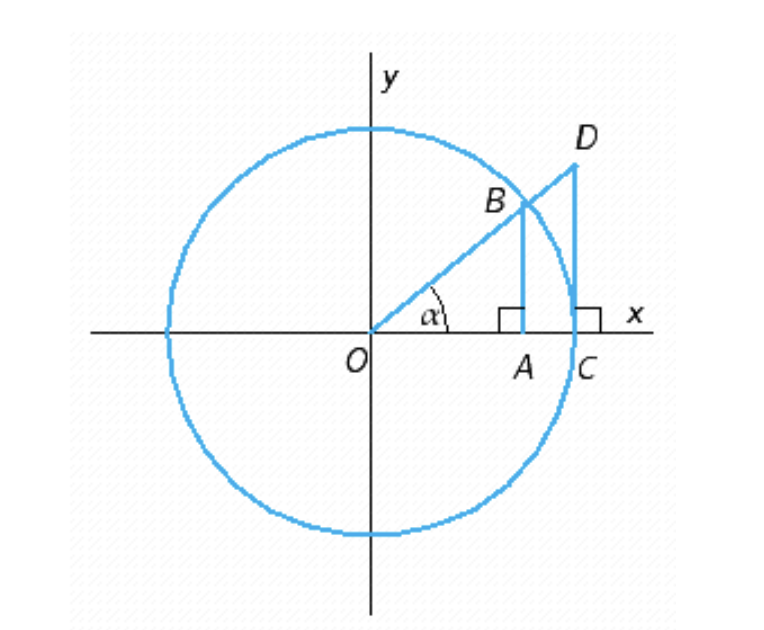
- The radius of the circle in the figure is 2 units. Express the length of \(DC\) in terms of \(\alpha\).
- Prove the identity: \(\frac{1-\cos\theta}{\sin\theta}+\frac{\sin\theta}{1-\cos\theta}=2\csc\theta.\) Then state all values of \(\theta\) in \([0,2\pi)\) for which the original identity is undefined.
- Prove the identity: \(\frac{\cot^2\theta-\tan^2\theta}{(\cot\theta+\tan\theta)^2}=2\cos^2\theta-1.\)
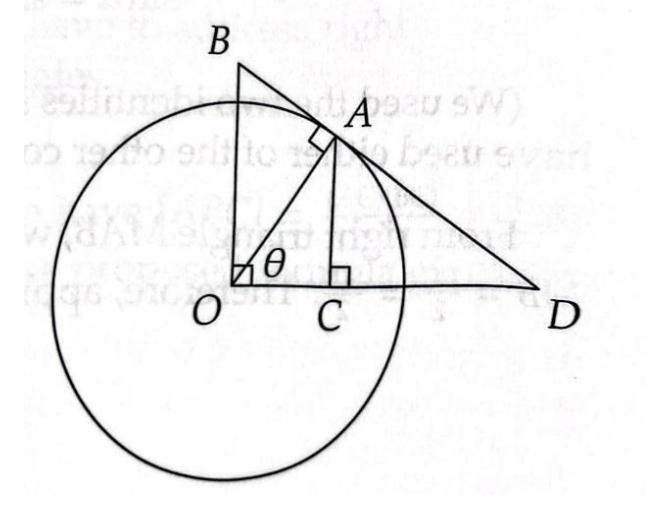
- For each of the following trigonometric expressions, find a segment in the diagram that has length equal to the trigonometric expression: \(\sin\theta, \cos\theta, \sec\theta, \csc\theta, \tan\theta, \cot\theta\). Note that you are not asked to express each trigonometric function in terms of multiple segments in the diagram. You must find a segment whose whole length equals the corresponding trig function. The graph is given below:
- On \([0,2\pi)\), solve the equation numerically to three decimal places: \(3\sin x-2\cos x=1.\) (Hint: Try the substitution \(t=\tan(x/2)\), and solve for \(x\) using the \(\tan^{-1}\) button on the calculator.)
- (Bonus, rational points on the unit circle)
The unit circle is
\[x^2+y^2=1.\]One obvious rational point on the unit circle is \((-1,0)\). Now draw a line with rational slope \(m\) through \((-1,0)\):
\[y=m(x+1).\]\((A)\) Substitute \(y=m(x+1)\) into \(x^2+y^2=1\) and show that the line intersects the unit circle at \((-1,0)\) and one other point.
\((B)\) Find the coordinates of the second intersection point in terms of \(m\).
\((C)\) Explain why every rational value of \(m\) gives a rational point on the unit circle.
\((D)\) Use your formula to find a rational point on the unit circle when \(m=\frac23\), then interpret that point as \((\cos\theta,\sin\theta)\) for some angle \(\theta\).
\((E)\) Why does this method not produce the point \((-1,0)\) as the second intersection point? What slope would be needed to reach the point \((1,0)\)?
Solutions
Solution 1
Add multiples of \(2\pi\) to find a positive coterminal angle:
\[-\frac{29\pi}{6}+3(2\pi) =-\frac{29\pi}{6}+\frac{36\pi}{6} =\frac{7\pi}{6}.\]This is positive, but not least positive, since
\[\frac{7\pi}{6}-2\pi=-\frac{5\pi}{6}<0.\]So the least positive coterminal angle is
\[\boxed{\frac{7\pi}{6}}.\]Convert the original angle to degrees:
\[-\frac{29\pi}{6}\cdot\frac{180}{\pi} =-870^\circ.\]Also,
\[\frac{7\pi}{6}\cdot\frac{180}{\pi} =210^\circ.\]Thus
\[\boxed{-\frac{29\pi}{6}=-870^\circ,\qquad \frac{7\pi}{6}=210^\circ}.\]The angle \(\frac{7\pi}{6}\) is in Quadrant III, and its reference angle is
\[\frac{7\pi}{6}-\pi=\frac{\pi}{6}.\]So
\[\boxed{\text{reference angle }=\frac{\pi}{6},\quad \text{Quadrant III}}.\]Since \(\theta\) is coterminal with \(\frac{7\pi}{6}\),
\[\sin\theta=-\frac12, \qquad \cos\theta=-\frac{\sqrt3}{2}, \qquad \tan\theta=\frac{\sqrt3}{3}.\]The reciprocal functions are
\[\csc\theta=-2, \qquad \sec\theta=-\frac{2\sqrt3}{3}, \qquad \cot\theta=\sqrt3.\]Solution 2
For a sector,
\[P=2r+s.\]Since \(s=r\theta\),
\[P=2r+r\theta=r(2+\theta).\]We are given \(P=40\) and \(\theta=\frac{5\pi}{6}\), so
\[40=r\left(2+\frac{5\pi}{6}\right).\]Thus
\[r=\frac{40}{2+\frac{5\pi}{6}} =\frac{240}{12+5\pi}.\]So
\[\boxed{r=\frac{240}{12+5\pi}\text{ cm}}.\]The arc length is
\[s=r\theta =\frac{240}{12+5\pi}\cdot\frac{5\pi}{6} =\frac{200\pi}{12+5\pi}.\]Thus
\[\boxed{s=\frac{200\pi}{12+5\pi}\text{ cm}}.\]The sector area is
\[A=\frac12r^2\theta.\]So
\[A=\frac12\left(\frac{240}{12+5\pi}\right)^2\left(\frac{5\pi}{6}\right) =\frac{24000\pi}{(12+5\pi)^2}.\]Therefore
\[\boxed{A=\frac{24000\pi}{(12+5\pi)^2}\text{ cm}^2}.\]Solution 3
The wheel rotates at
\[45\text{ rev/min}=45(2\pi)=90\pi\text{ rad/min}.\]Convert to radians per second:
\[\omega=\frac{90\pi}{60}=\frac{3\pi}{2}\text{ rad/sec}.\]The bug starts at the point closest to the ground, so its starting angle is
\[\frac{3\pi}{2}.\]After \(7\) seconds, the angle swept out is
\[\omega t=\frac{3\pi}{2}(7)=\frac{21\pi}{2}.\]The total angle is
\[\frac{3\pi}{2}+\frac{21\pi}{2} =\frac{24\pi}{2} =12\pi.\]This is coterminal with \(0\), so the bug is at
\[\boxed{(18,0)}.\]The angle in standard position is
\[\boxed{0\text{ radians}}\]after reducing coterminally.
The linear speed is
\[v=r\omega=18\cdot\frac{3\pi}{2}=27\pi.\]Thus
\[\boxed{v=27\pi\text{ cm/sec}}.\]Solution 4
Wheel A rotates at
\[150\text{ rev/min}=300\pi\text{ rad/min}.\]Its linear speed is
\[v=r\omega=4(300\pi)=1200\pi\text{ in/min}.\]The belt does not slip, so Wheel B has the same linear speed.
Wheel B rotates at
\[60\text{ rev/min}=120\pi\text{ rad/min}.\]So
\[1200\pi=r_B(120\pi).\]Therefore
\[\boxed{r_B=10\text{ inches}}.\]Convert the belt speed to inches per second:
\[1200\pi\text{ in/min} =\frac{1200\pi}{60}\text{ in/sec} =20\pi\text{ in/sec}.\]Thus
\[\boxed{20\pi\text{ in/sec}}.\]Solution 5
Since \(\theta\) is in Quadrant II and
\[\tan\theta=-\frac{8}{15},\]we can use a reference triangle with opposite side \(8\), adjacent side \(-15\), and hypotenuse
\[\sqrt{8^2+15^2}=17.\]Thus
\[\boxed{\sin\theta=\frac8{17}}, \qquad \boxed{\cos\theta=-\frac{15}{17}}, \qquad \boxed{\tan\theta=-\frac8{15}}.\]The reciprocal functions are
\[\boxed{\sec\theta=-\frac{17}{15}}, \qquad \boxed{\csc\theta=\frac{17}{8}}, \qquad \boxed{\cot\theta=-\frac{15}{8}}.\]Now,
\[\sin(\pi-\theta)=\sin\theta=\frac8{17}.\]Also,
\[\cos(\theta+\pi)=-\cos\theta=\frac{15}{17}.\]So
\[\boxed{\sin(\pi-\theta)=\frac8{17}}, \qquad \boxed{\cos(\theta+\pi)=\frac{15}{17}}.\]Solution 6
Since \(P=(x,y)\) is on the unit circle,
\[x^2+y^2=1.\]We are also given
\[x-y=\frac{\sqrt2}{2}.\]So
\[y=x-\frac{\sqrt2}{2}.\]Substitute:
\[x^2+\left(x-\frac{\sqrt2}{2}\right)^2=1.\]Expand:
\[x^2+x^2-\sqrt2x+\frac12=1.\]Thus
\[2x^2-\sqrt2x-\frac12=0.\]Multiply by \(2\):
\[4x^2-2\sqrt2x-1=0.\]Use the quadratic formula:
\[x=\frac{2\sqrt2\pm\sqrt{8+16}}{8} =\frac{2\sqrt2\pm2\sqrt6}{8} =\frac{\sqrt2\pm\sqrt6}{4}.\]Since the point is in Quadrant III, \(x<0\). Therefore
\[x=\frac{\sqrt2-\sqrt6}{4}.\]Then
\[y=x-\frac{\sqrt2}{2} =\frac{\sqrt2-\sqrt6}{4}-\frac{2\sqrt2}{4} =-\frac{\sqrt2+\sqrt6}{4}.\]So
\[\boxed{P=\left(\frac{\sqrt2-\sqrt6}{4},-\frac{\sqrt2+\sqrt6}{4}\right)}.\]This is the unit-circle point for
\[\boxed{\theta=\frac{17\pi}{12}}.\]Equivalently, \(\theta\approx4.451\) radians.
Solution 7
Use coterminal angles:
\[\sin\left(-\frac{7\pi}{6}\right)=\sin\left(\frac{5\pi}{6}\right)=\frac12.\]Also,
\[\cos\left(\frac{11\pi}{3}\right)=\cos\left(\frac{5\pi}{3}\right)=\frac12.\]Next,
\[\tan\left(-\frac{13\pi}{4}\right)=\tan\left(\frac{3\pi}{4}\right)=-1.\]Finally,
\[\sec\left(\frac{17\pi}{6}\right)=\sec\left(\frac{5\pi}{6}\right) =\frac1{-\frac{\sqrt3}{2}} =-\frac{2\sqrt3}{3}.\]Substitute:
\[6\left(\frac12\right) -4\left(\frac12\right) +3(-1) -2\left(-\frac{2\sqrt3}{3}\right).\]This becomes
\[3-2-3+\frac{4\sqrt3}{3}.\]Therefore
\[\boxed{-2+\frac{4\sqrt3}{3}}.\]Solution 8
Let
\[u=\sin x.\]Then
\[2u^2-u-1=0.\]Factor:
\[(2u+1)(u-1)=0.\]Thus
\[\sin x=1 \qquad\text{or}\qquad \sin x=-\frac12.\]On \([0,4\pi)\), \(\sin x=1\) at
\[x=\frac{\pi}{2},\frac{5\pi}{2}.\]Also, \(\sin x=-\frac12\) at
\[x=\frac{7\pi}{6},\frac{11\pi}{6},\frac{19\pi}{6},\frac{23\pi}{6}.\]Therefore
\[\boxed{x=\frac{\pi}{2},\frac{7\pi}{6},\frac{11\pi}{6},\frac{5\pi}{2},\frac{19\pi}{6},\frac{23\pi}{6}}.\]Solution 9
Let
\[u=\cos x.\]Then
\[2u^2+\sqrt3u-1=0.\]Use the quadratic formula:
\[u=\frac{-\sqrt3\pm\sqrt{3+8}}{4} =\frac{-\sqrt3\pm\sqrt{11}}{4}.\]The value
\[\frac{-\sqrt3-\sqrt{11}}{4}\]is less than \(-1\), so it is impossible for \(\cos x\). Thus
\[\cos x=\frac{\sqrt{11}-\sqrt3}{4}.\]On \([0,2\pi)\), cosine is positive in Quadrants I and IV, so
\[\boxed{x=\cos^{-1}\left(\frac{\sqrt{11}-\sqrt3}{4}\right) \quad\text{or}\quad x=2\pi-\cos^{-1}\left(\frac{\sqrt{11}-\sqrt3}{4}\right)}.\]Solution 10
We have
\[\tan^2x-3=0.\]So
\[\tan^2x=3,\]which gives
\[\tan x=\pm\sqrt3.\]The tangent function has period \(\pi\). On \([0,3\pi)\), the solutions are
\[\boxed{x=\frac{\pi}{3},\frac{2\pi}{3},\frac{4\pi}{3},\frac{5\pi}{3},\frac{7\pi}{3},\frac{8\pi}{3}}.\]Solution 11
The radius of the circle is \(2\), and \(C\) is the point on the positive \(x\)-axis at the right edge of the circle. Thus
\[OC=2.\]The ray from \(O\) through \(B\) and \(D\) makes angle \(\alpha\) with the positive \(x\)-axis. In right triangle \(ODC\),
\[\tan\alpha=\frac{DC}{OC}.\]Substitute \(OC=2\):
\[\tan\alpha=\frac{DC}{2}.\]Therefore
\[\boxed{DC=2\tan\alpha}.\]Solution 12
Start with the left-hand side:
\[\frac{1-\cos\theta}{\sin\theta}+\frac{\sin\theta}{1-\cos\theta}.\]Use the common denominator \(\sin\theta(1-\cos\theta)\):
\[\frac{(1-\cos\theta)^2+\sin^2\theta}{\sin\theta(1-\cos\theta)}.\]Expand the numerator:
\[1-2\cos\theta+\cos^2\theta+\sin^2\theta.\]Use \(\sin^2\theta+\cos^2\theta=1\):
\[1-2\cos\theta+\cos^2\theta+\sin^2\theta =2-2\cos\theta.\]So the expression becomes
\[\frac{2-2\cos\theta}{\sin\theta(1-\cos\theta)}.\]Factor:
\[\frac{2(1-\cos\theta)}{\sin\theta(1-\cos\theta)}.\]Cancel:
\[\frac2{\sin\theta}=2\csc\theta.\]Therefore
\[\boxed{\frac{1-\cos\theta}{\sin\theta}+\frac{\sin\theta}{1-\cos\theta}=2\csc\theta}.\]The original expression is undefined when
\[\sin\theta=0\]or
\[1-\cos\theta=0.\]On \([0,2\pi)\), this happens at
\[\boxed{\theta=0,\pi}.\]Solution 13
Start with the left-hand side:
\[\frac{\cot^2\theta-\tan^2\theta}{(\cot\theta+\tan\theta)^2}.\]Factor the numerator:
\[\frac{(\cot\theta-\tan\theta)(\cot\theta+\tan\theta)}{(\cot\theta+\tan\theta)^2}.\]Cancel one factor:
\[\frac{\cot\theta-\tan\theta}{\cot\theta+\tan\theta}.\]Rewrite in terms of sine and cosine:
\[\frac{\frac{\cos\theta}{\sin\theta}-\frac{\sin\theta}{\cos\theta}}{\frac{\cos\theta}{\sin\theta}+\frac{\sin\theta}{\cos\theta}}.\]Multiply the top and bottom by \(\sin\theta\cos\theta\):
\[\frac{\cos^2\theta-\sin^2\theta}{\cos^2\theta+\sin^2\theta}.\]Since \(\cos^2\theta+\sin^2\theta=1\), this becomes
\[\cos^2\theta-\sin^2\theta.\]Use \(\sin^2\theta=1-\cos^2\theta\):
\[\cos^2\theta-(1-\cos^2\theta) =2\cos^2\theta-1.\]Thus
\[\boxed{\frac{\cot^2\theta-\tan^2\theta}{(\cot\theta+\tan\theta)^2}=2\cos^2\theta-1}.\]Solution 14
In the diagram, the circle is the unit circle and \(A=(\cos\theta,\sin\theta)\).
The horizontal segment from the origin to the foot under \(A\) is
\[\boxed{OC=\cos\theta}.\]The vertical segment from the \(x\)-axis up to \(A\) is
\[\boxed{AC=\sin\theta}.\]The line through \(A\) is tangent to the unit circle. Its equation is
\[x\cos\theta+y\sin\theta=1.\]At the \(x\)-intercept, \(y=0\), so
\[x\cos\theta=1\]and
\[x=\sec\theta.\]Thus
\[\boxed{OD=\sec\theta}.\]At the \(y\)-intercept, \(x=0\), so
\[y\sin\theta=1\]and
\[y=\csc\theta.\]Thus
\[\boxed{OB=\csc\theta}.\]The tangent segment from \(A\) to \(D\) has length
\[AD=\sqrt{(\sec\theta-\cos\theta)^2+(0-\sin\theta)^2}.\]Since
\[\sec\theta-\cos\theta =\frac1{\cos\theta}-\cos\theta =\frac{1-\cos^2\theta}{\cos\theta} =\frac{\sin^2\theta}{\cos\theta},\]this length simplifies to \(\tan\theta\) in the first-quadrant diagram. Therefore
\[\boxed{AD=\tan\theta}.\]The tangent segment from \(A\) to \(B\) has length
\[AB=\sqrt{(0-\cos\theta)^2+(\csc\theta-\sin\theta)^2}.\]Similarly,
\[\csc\theta-\sin\theta =\frac1{\sin\theta}-\sin\theta =\frac{\cos^2\theta}{\sin\theta},\]so this length simplifies to \(\cot\theta\) in the first-quadrant diagram. Therefore
\[\boxed{AB=\cot\theta}.\]So the six matching segments are
\[\boxed{\sin\theta=AC,\quad \cos\theta=OC,\quad \sec\theta=OD,\quad \csc\theta=OB,\quad \tan\theta=AD,\quad \cot\theta=AB}.\]Solution 15
Use the substitution
\[t=\tan\frac{x}{2}.\]Then
\[\sin x=\frac{2t}{1+t^2}\]and
\[\cos x=\frac{1-t^2}{1+t^2}.\]Substitute into
\[3\sin x-2\cos x=1.\]This gives
\[3\left(\frac{2t}{1+t^2}\right)-2\left(\frac{1-t^2}{1+t^2}\right)=1.\]Multiply by \(1+t^2\):
\[6t-2(1-t^2)=1+t^2.\]Expand:
\[6t-2+2t^2=1+t^2.\]Rearrange:
\[t^2+6t-3=0.\]Use the quadratic formula:
\[t=\frac{-6\pm\sqrt{36+12}}{2} =-3\pm2\sqrt3.\]So
\[\tan\frac{x}{2}=-3+2\sqrt3\]or
\[\tan\frac{x}{2}=-3-2\sqrt3.\]Using a calculator and choosing values of \(x\) in \([0,2\pi)\) gives
\[\boxed{x\approx0.869\quad\text{or}\quad x\approx3.450}.\]Solution 16
For part \((A)\), substitute
\[y=m(x+1)\]into
\[x^2+y^2=1.\]This gives
\[x^2+m^2(x+1)^2=1.\]Expand:
\[x^2+m^2(x^2+2x+1)=1.\]So
\[(1+m^2)x^2+2m^2x+m^2-1=0.\]Since \(x=-1\) is one solution, factor:
\[(x+1)\left((1+m^2)x+(m^2-1)\right)=0.\]Therefore the line intersects the circle at \((-1,0)\) and one other point.
For part \((B)\), the second point comes from
\[(1+m^2)x+(m^2-1)=0.\]Thus
\[x=\frac{1-m^2}{1+m^2}.\]Now plug into \(y=m(x+1)\):
\[y=m\left(\frac{1-m^2}{1+m^2}+1\right).\]Simplify:
\[y=m\left(\frac{1-m^2+1+m^2}{1+m^2}\right) =m\left(\frac{2}{1+m^2}\right) =\frac{2m}{1+m^2}.\]So the second intersection point is
\[\boxed{\left(\frac{1-m^2}{1+m^2},\frac{2m}{1+m^2}\right)}.\]For part \((C)\), if \(m\) is rational, then \(m^2\) is rational. The expressions
\[\frac{1-m^2}{1+m^2} \qquad\text{and}\qquad \frac{2m}{1+m^2}\]are made from rational numbers using addition, subtraction, multiplication, and division. Therefore both coordinates are rational.
For part \((D)\), use \(m=\frac23\):
\[x=\frac{1-\left(\frac23\right)^2}{1+\left(\frac23\right)^2} =\frac{1-\frac49}{1+\frac49} =\frac{\frac59}{\frac{13}{9}} =\frac5{13}.\]Also,
\[y=\frac{2\left(\frac23\right)}{1+\left(\frac23\right)^2} =\frac{\frac43}{\frac{13}{9}} =\frac{12}{13}.\]So the rational point is
\[\boxed{\left(\frac5{13},\frac{12}{13}\right)}.\]This means there is an angle \(\theta\) such that
\[\boxed{\cos\theta=\frac5{13},\qquad \sin\theta=\frac{12}{13}}.\]For part \((E)\), this method does not produce \((-1,0)\) as the second intersection point because \((-1,0)\) is the fixed point used to build every line. A finite nonvertical slope through \((-1,0)\) intersects the circle at exactly one other point.
To reach \((1,0)\), the line must be the \(x\)-axis, which has slope
\[\boxed{m=0}.\]