AP Chemistry Cheat Sheet
This page is a high-yield AP Chemistry reference sheet. It collects the most important concepts, formulas, trends, and problem-solving checks from Units 1-9 in one place. It is best used as a last-minute review tool or a quick lookup page while studying a full unit. Always remember that you have a formula sheet for the AP test!
Constants and Common Values
- Avogadro’s Number: \(N_A = 6.022 \times 10^{23}\ \text{mol}^{-1}\)
- Ideal Gas Constant: \(R = 0.08206\ \text{L·atm/(mol·K)} = 8.314\ \text{J/(mol·K)}\)
- Faraday’s Constant: \(F = 96485\ \text{C/mol e}^-\)
- Specific heat of water: \(c_{\text{water}} \approx 4.18\ \text{J/(g·^\circ C)}\)
- Pressure conversions: \(1\ \text{atm} = 760\ \text{mmHg} = 760\ \text{torr} = 101.325\ \text{kPa}\)
- STP for AP Chem: \(273.15\ \text{K}\) and \(1\ \text{atm}\)
- Molar volume of an ideal gas at STP: about \(22.4\ \text{L/mol}\)
- \(K_w = 1.0 \times 10^{-14}\) at \(25^\circ\text{C}\)
Unit 1: Atomic Structure and Properties
Essential ideas
- Mass number = protons + neutrons
- Atomic number = protons
- Average atomic mass is a weighted average of isotopes
- Moles connect microscopic particles to measurable mass
- Molarity:
Electron configuration
- Aufbau order matters
- Pauli exclusion: max 2 electrons per orbital with opposite spin
- Hund’s rule: fill equal-energy orbitals singly first
Common order:
\[1s,\ 2s,\ 2p,\ 3s,\ 3p,\ 4s,\ 3d,\ 4p,\ 5s,\ 4d,\ 5p,\ 6s,\ 4f,\ 5d,\ 6p\]Periodic trends
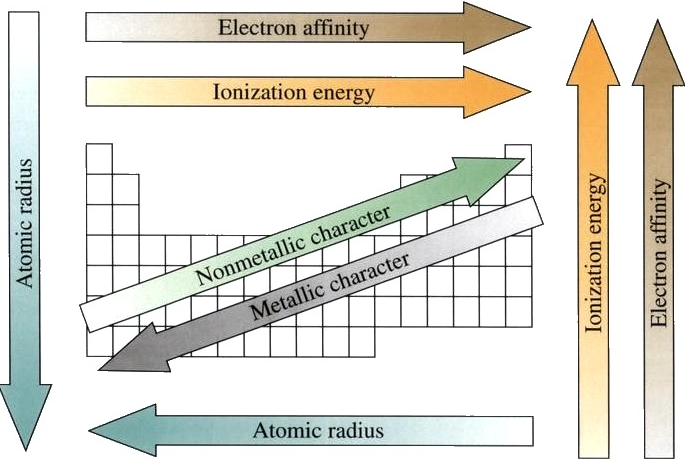
- Atomic radius: increases down, decreases across
- Ionization energy: decreases down, increases across
- Electron affinity: usually becomes more favorable across a period
- Electronegativity: decreases down, increases across
- More positive effective nuclear charge usually means electrons are held more tightly
Photoelectron spectroscopy
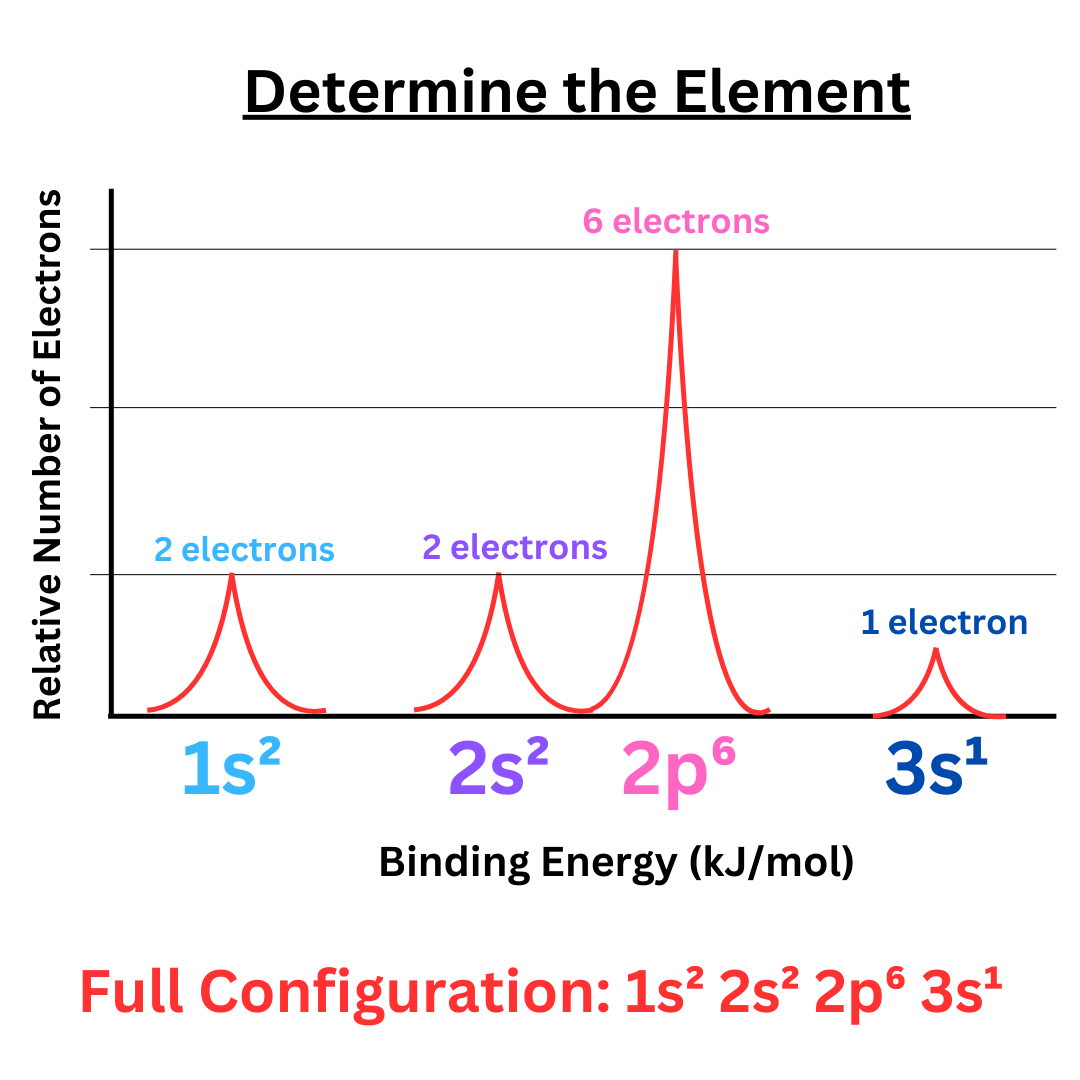
- Lower binding energy means easier to remove electron (so elements with higher nuclear charge have charts that are shifted left)
- Higher peaks can mean more electrons in a subshell
- Peak position tells energy level; peak height/area tracks electron count
Unit 2: Compound Structure and Properties
Bond types
- Ionic: metal + nonmetal, electron transfer
- Covalent: nonmetal + nonmetal, electron sharing
- Metallic: metal cations in a sea of delocalized electrons
Lewis structures checklist
- Count valence electrons
- Pick central atom
- Connect atoms with single bonds
- Complete octets on outer atoms
- Place remaining electrons on central atom
- Make multiple bonds if needed
- Check formal charges
Formal charge
\[\text{FC} = \text{valence} - \text{nonbonding} - \frac{1}{2}(\text{bonding})\]VSEPR / geometry
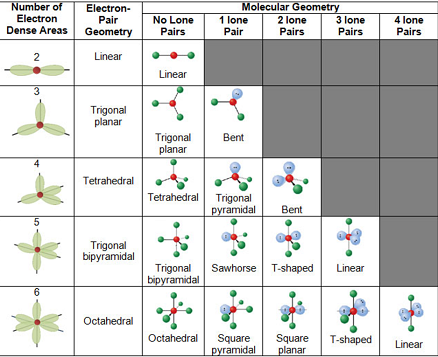
- 2 electron groups: linear
- 3: trigonal planar
- 4: tetrahedral
- 5: trigonal bipyramidal
- 6: octahedral
Molecular shape depends on lone pairs.
Hybridization
- 2 groups: \(sp\)
- 3 groups: \(sp^2\)
- 4 groups: \(sp^3\)
- 5 groups: \(sp^3d\)
- 6 groups: \(sp^3d^2\)
Bond order and bond properties
- Higher bond order -> shorter, stronger bond
- Longer bonds are usually weaker
Unit 3: Substances and Mixtures
Intermolecular forces
Weakest to strongest, in common AP contexts:
- London dispersion
- Dipole-dipole
- Hydrogen bonding
- Ion-dipole
“Like dissolves like”
- Polar dissolves polar
- Nonpolar dissolves nonpolar
- Ionic compounds usually dissolve best in polar solvents
Gas laws
\[PV = nRT\] \[P_{\text{total}} = \sum P_i\] \[P_i = x_i P_{\text{total}}\]Kinetic theory
- Higher temperature -> higher average kinetic energy
- For ideal gases:
Graham’s law
\[\frac{\text{rate}_1}{\text{rate}_2} = \sqrt{\frac{M_2}{M_1}}\]Colligative properties
\[\Delta T_b = iK_bm\] \[\Delta T_f = iK_fm\] \[\Pi = iMRT\]Unit 4: Chemical Reactions
Reaction types
- Synthesis
- Decomposition
- Single replacement
- Double replacement
- Combustion
- Acid-base
- Redox
Net ionic equations
- Split strong electrolytes into ions
- Keep solids, liquids, gases, and weak electrolytes intact
- Cancel spectator ions
Solubility rules to memorize
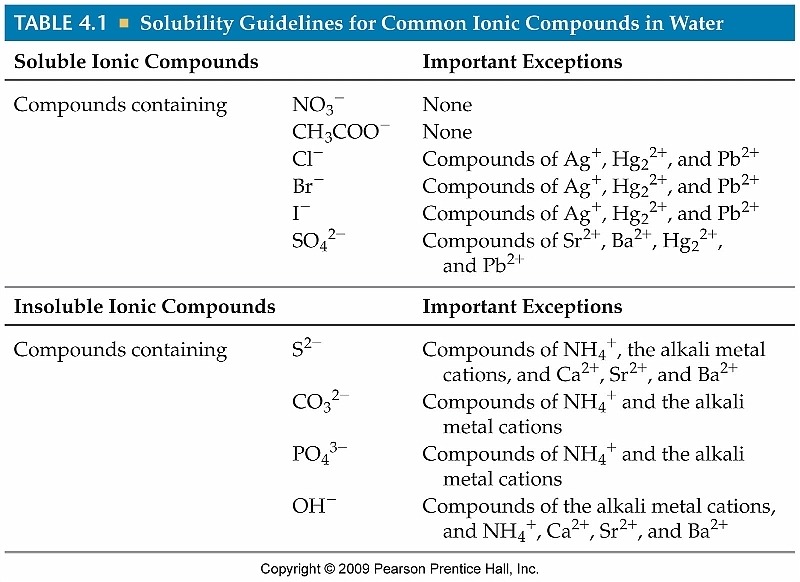
- Always soluble: Group 1, \(\text{NH}_4^+\), \(\text{NO}_3^-\), acetate, chlorate, perchlorate
- Usually soluble: halides except with \(\text{Ag}^+\), \(\text{Pb}^{2+}\), \(\text{Hg}_2^{2+}\)
- Usually soluble: sulfates except with \(\text{Ba}^{2+}\), \(\text{Sr}^{2+}\), \(\text{Pb}^{2+}\), often \(\text{Ca}^{2+}\)
- Usually insoluble: carbonates, phosphates, chromates, sulfides, hydroxides except with Group 1 and \(\text{NH}_4^+\)
Oxidation number reminders
- Element alone: 0
- Monatomic ion: charge
- Oxygen: usually -2
- Hydrogen: usually +1 with nonmetals, -1 with metals
- Sum of oxidation numbers = overall charge
Unit 5: Kinetics
Core ideas
- Rate depends on concentration, temperature, orientation, and activation energy
- Catalyst lowers activation energy but does not change \(\Delta H\) or \(K\)
Rate law
\[\text{rate} = k[A]^m[B]^n\]- Orders come from experiment, not from the balanced equation unless the step is elementary
Integrated rate laws
Zeroth:
\[[A] = [A]_0 - kt\]First:
\[\ln[A] = \ln[A]_0 - kt\]Second:
\[\frac{1}{[A]} = \frac{1}{[A]_0} + kt\]Half-life
Zeroth:
\[t_{1/2} = \frac{[A]_0}{2k}\]First:
\[t_{1/2} = \frac{0.693}{k}\]Second:
\[t_{1/2} = \frac{1}{k[A]_0}\]Arrhenius equation
\[k = Ae^{-E_a/(RT)}\] \[\ln k = -\frac{E_a}{R}\frac{1}{T} + \ln A\]Unit 6: Thermochemistry
Heat and calorimetry
\[q = mc\Delta T\]First law
\[\Delta U = q + w\]Pressure-volume work
\[w = -P_{\text{ext}}\Delta V\]Enthalpy
At constant pressure:
\[\Delta H = q_p\]Hess’s law
- Reverse reaction -> change sign of \(\Delta H\)
- Multiply equation -> multiply \(\Delta H\)
- Add equations -> add \(\Delta H\)
Formation enthalpies
\[\Delta H^\circ_{\text{rxn}} = \sum \nu \Delta H_f^\circ(\text{products}) - \sum \nu \Delta H_f^\circ(\text{reactants})\]Bond enthalpy estimate
\[\Delta H_{\text{rxn}} \approx \sum D(\text{broken}) - \sum D(\text{formed})\]Unit 7: Equilibrium
Core equilibrium idea
At equilibrium:
- forward rate = reverse rate
- concentrations are constant, not necessarily equal
Equilibrium expression
For
\[aA + bB \rightleftharpoons cC + dD\] \[K_c = \frac{[C]^c[D]^d}{[A]^a[B]^b}\]Pure solids and liquids are omitted.
Reaction quotient
- \(Q < K\) -> shifts right
- \(Q > K\) -> shifts left
- \(Q = K\) -> already at equilibrium
Gas-phase equilibrium
\[K_p = K_c(RT)^{\Delta n_{\text{gas}}}\]ICE table logic
Initial, Change, Equilibrium
- use stoichiometric multiples of \(x\)
- approximation may work if \(x\) is very small compared with initial concentration
Le Châtelier
- Add reactant -> shift right
- Add product -> shift left
- Increase pressure -> shift toward fewer moles gas
- Change temperature -> changes \(K\)
- Catalyst -> no change in \(K\)
Solubility product
\[K_{sp} = [\text{ions}]^{\text{coefficients}}\]Thermodynamic connection
\[\Delta G^\circ = -RT\ln K\]Unit 8: Acid-Base Equilibrium
Definitions
- Arrhenius: acids increase \([H^+]\), bases increase \([OH^-]\)
- Brønsted-Lowry: acid donates proton, base accepts proton
- Lewis: acid accepts electron pair, base donates electron pair
Strong acids to memorize
\[\text{HCl},\ \text{HBr},\ \text{HI},\ \text{HNO}_3,\ \text{HClO}_4,\ \text{HClO}_3,\ \text{H}_2\text{SO}_4 \text{ (first proton)}\]Strong bases to memorize
Group 1 hydroxides and heavier Group 2 hydroxides:
\[\text{LiOH},\ \text{NaOH},\ \text{KOH},\ \text{Ca(OH)}_2,\ \text{Sr(OH)}_2,\ \text{Ba(OH)}_2\]Weak acid/base equilibrium
\[K_a = \frac{[H_3O^+][A^-]}{[HA]}\] \[K_b = \frac{[BH^+][OH^-]}{[B]}\] \[K_aK_b = K_w\]pH / pOH
\[\text{pH} = -\log[H_3O^+]\] \[\text{pOH} = -\log[OH^-]\] \[\text{pH} + \text{pOH} = 14\]at \(25^\circ\text{C}\).
Buffer equation
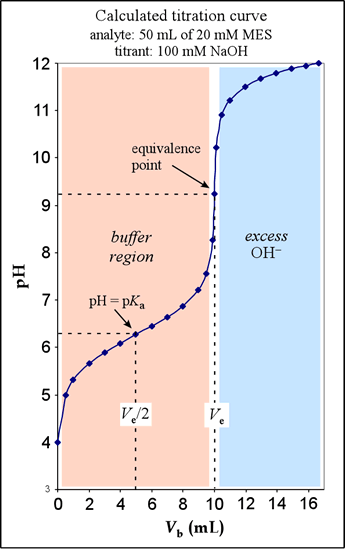
\[\text{pH} = \text{p}K_a + \log\left(\frac{[A^-]}{[HA]}\right)\]Titration checkpoints
- strong acid / strong base equivalence point near pH 7
- weak acid / strong base equivalence point above 7
- weak base / strong acid equivalence point below 7
- half-equivalence point for weak acid/base gives \(\text{pH} = \text{p}K_a\) or \(\text{pOH} = \text{p}K_b\)
Unit 9: Thermodynamics and Electrochemistry
Entropy and spontaneity
\[\Delta S_{\text{universe}} = \Delta S_{\text{system}} + \Delta S_{\text{surroundings}}\]- spontaneous if \(\Delta S_{\text{universe}} > 0\)
- equilibrium if \(\Delta S_{\text{universe}} = 0\)
Gibbs free energy
\[\Delta G = \Delta H - T\Delta S\]- spontaneous if \(\Delta G < 0\)
- equilibrium if \(\Delta G = 0\)
Standard free energy
\[\Delta G^\circ = -RT\ln K\]Electrochemistry
\[\Delta G = -nFE_{\text{cell}}\] \[E^\circ_{\text{cell}} = E^\circ_{\text{cathode}} - E^\circ_{\text{anode}}\]Nernst equation
\[E_{\text{cell}} = E^\circ_{\text{cell}} - \frac{RT}{nF}\ln Q\]At \(25^\circ\text{C}\):
\[E_{\text{cell}} = E^\circ_{\text{cell}} - \frac{0.0592}{n}\log Q\]Faraday’s law
\[q = It = nF\] \[m = \frac{MIt}{nF}\]Galvanic vs electrolytic
- galvanic: spontaneous, anode negative, cathode positive
- electrolytic: nonspontaneous, anode positive, cathode negative
- oxidation always at anode
- reduction always at cathode

Most Common AP Chemistry Mistakes
- Forgetting units or using Celsius instead of Kelvin in gas/equilibrium/thermo work
- Including solids or liquids in equilibrium expressions
- Pulling rate-law exponents from the balanced equation without justification
- Forgetting stoichiometric coefficients in equilibrium, entropy, or formation-energy sums
- Mixing up anode/cathode with sign in galvanic vs electrolytic cells
- Forgetting to do stoichiometry first in titration and buffer problems
- Treating a catalyst as something that changes \(K\) or \(\Delta G^\circ\)
- Confusing molecular polarity with bond polarity
Fast Problem-Solving Checklist
- Write the balanced equation first.
- Identify what unit/topic the problem belongs to.
- Decide whether the problem is stoichiometric, equilibrium-based, energetic, or statistical/rate-based.
- Track units before plugging in numbers.
- Check whether the answer sign and magnitude make chemical sense.
- For FRQs, explain with both particle-level logic and equation-level support when possible.