Unit 5: Exponential & Logarithmic Functions
Exponential functions
An exponential function has the form
\[y=b^x,\]where
\[b>0 \qquad\text{and}\qquad b\ne 1.\]The base \(b\) is constant, and the variable is in the exponent. This is different from a power function like
\[y=x^n,\]where the base is variable and the exponent is constant.
We require \(b>0\) because negative bases can break continuity over the real numbers. For example, with
\[y=(-2)^x,\]integer inputs are fine, but many fractional inputs are not real-valued in a consistent way. We also exclude \(b=1\) because
\[y=1^x=1\]is just a constant function, not exponential growth or decay.
Growth and decay
For
\[y=b^x,\]there are two basic shapes:
- If \(b>1\), the function is increasing and represents exponential growth.
- If \(0<b<1\), the function is decreasing and represents exponential decay.
Both have:
- Domain: \((-\infty,\infty)\).
- Range: \((0,\infty)\).
- Horizontal asymptote: \(y=0\).
- \(y\)-intercept: \((0,1)\).
The decay case can always be rewritten using a reciprocal base:
\[b^{-x}=\left(\frac1b\right)^x.\]For example,
\[2^{-x}=\left(\frac12\right)^x.\]But, you should always be careful with signs:
\[-2^x=-(2^x),\]which is a reflection of \(2^x\) over the \(x\)-axis. It is not the same as \((-2)^x\).
Transformations
A transformed exponential function often looks like
\[y=a\cdot b^{x-h}+k.\]The transformation rules are the same as other parent functions:
- \(a\) vertically stretches/compresses and reflects over the \(x\)-axis if \(a<0\).
- \(h\) shifts the graph horizontally.
- \(k\) shifts the graph vertically.
The horizontal asymptote moves from \(y=0\) to
\[y=k.\]A good idea is to always plot a couple of integer points to start with.
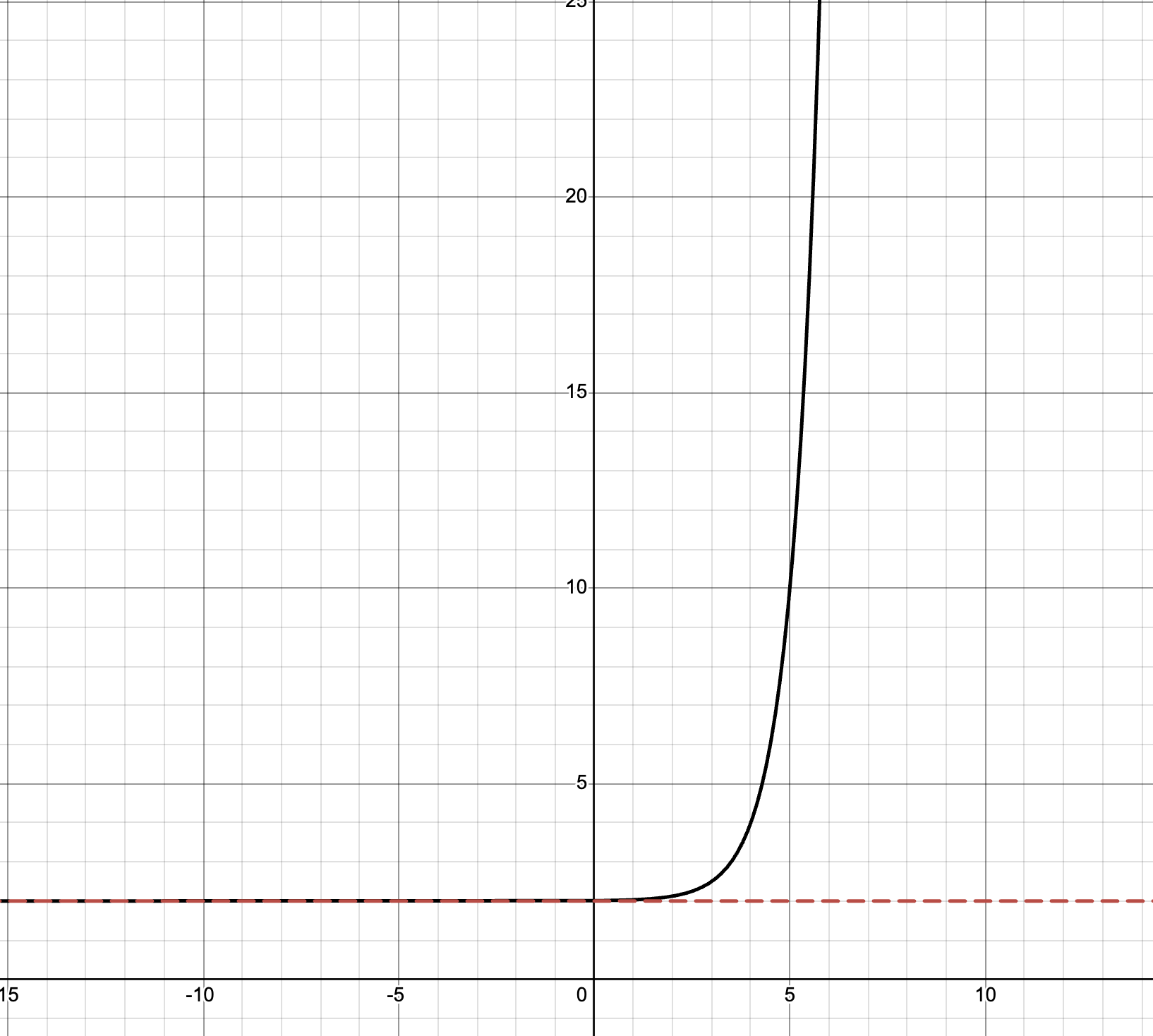
Example. Graph the function and give the domain and range of
\[y=\frac12(4)^{x-3}+2.\]The parent function \(4^x\) is exponential growth because \(4>1\). The expression \(x-3\) shifts the graph right \(3\) units, the factor \(\frac12\) vertically compresses it, and the \(+2\) shifts it up \(2\) units.
The horizontal asymptote is
\[y=2.\]The domain is
\[(-\infty,\infty).\]Since \(\frac12(4)^{x-3}>0\) for every real \(x\), the range is
\[(2,\infty).\]The graph is shown below (Note that the scale is a bit off, the dashed line is the horizontal asymptote):
The natural exponential function
The natural exponential function is defined as
\[y=e^x,\]where \(e\) (Euler’s number) is a special constant. One property of \(e\) is that:
\[e=\lim_{x\to\infty}\left(1+\frac1x\right)^x.\]Numerically, as \(x\) gets very large, the expression gets closer and closer to \(e\). After plugging in larger and larger values of \(x\), you find that \(e\approx 2.71828\). In addition, the instantaneous rate of change of \(y=e^x\) is equal to itself! We will demonstrate this below:
Example. Approximate the rate of change of \(e^x\) for smaller and smaller intervals.
Rhe average rate of change on \([1,1.1]\) is
\[\frac{e^{1.1}-e^1}{1.1-1}\approx 2.8588.\]On smaller intervals:
\[[1,1.01]\quad\Rightarrow\quad 2.7319,\] \[[1,1.001]\quad\Rightarrow\quad 2.7196,\] \[[1,1.0000001]\quad\Rightarrow\quad 2.71829.\]As the interval gets smaller, the rate of change becomes increasingly instantaneous. One reason why \(e^x\) is studied so much is topics like calculus is that it is equal to its own instantaneous rate of change, like derivatives!
\(e^x\) is an exponential growth function because \(e>1\). Like other exponential functions, it has domain \((-\infty,\infty)\), range \((0,\infty)\), horizontal asymptote \(y=0\), and \(y\)-intercept \((0,1)\).
Hyperbolic sine and cosine
The exponential function also appears in the definitions of the hyperbolic sine and hyperbolic cosine functions:
\[\sinh x=\frac12(e^x-e^{-x}),\]and
\[\cosh x=\frac12(e^x+e^{-x}).\]These are pronounced “cinch” and “cosh.” They behave somewhat like trigonometric functions, but they are built from exponentials.
Example. Show that
\[(\cosh x)^2=\frac12(\cosh(2x)+1).\]Using the definition,
\[(\cosh x)^2 =\left(\frac12(e^x+e^{-x})\right)^2.\]Square:
\[(\cosh x)^2 =\frac14(e^{2x}+2+e^{-2x}).\]Rewrite:
\[\frac14(e^{2x}+2+e^{-2x}) =\frac12\left(\frac12(e^{2x}+e^{-2x})+1\right).\]Since
\[\cosh(2x)=\frac12(e^{2x}+e^{-2x}),\]we get
\[(\cosh x)^2=\frac12(\cosh(2x)+1).\]Similarly,
\[(\sinh x)^2=\frac12(\cosh(2x)-1).\]Logarithmic functions
A logarithm is the inverse function of an exponent. The expression
\[y = \log_b x\]means “\(y\) is the the exponent you put on \(b\) to get \(x\).”
In equation form:
\[\log_b x=y \quad\Longleftrightarrow\quad b^y=x.\]The base must satisfy
\[b>0 \qquad\text{and}\qquad b\ne 1.\]The input must satisfy
\[x>0.\]So the parent logarithmic function
\[y=\log_b x\]has:
- Domain: \((0,\infty)\).
- Range: \((-\infty,\infty)\).
- Vertical asymptote: \(x=0\).
- \(x\)-intercept: \((1,0)\).
Note that this is the opposite of the exponent function, which is expected since they are inverses! Accordingly, the graph of \(y=\log_b x\) is the reflection of \(y=b^x\) across the line \(y=x\).
Example. Evaluate each logarithm.
\[1. \log_3 9 2. \log_5\left(\frac1{25}\right) 3. \log_8 32\]First,
\[\log_3 9=2\]because
\[3^2=9.\]Also,
\[\log_5\left(\frac1{25}\right)=-2\]because
\[5^{-2}=\frac1{25}.\]Finally,
\[\log_8 32=\frac53\]because
\[8^{5/3}=(2^3)^{5/3}=2^5=32.\]Increasing and decreasing logs
For
\[y=\log_b x,\]the shape depends on the base:
- If \(b>1\), then \(\log_b x\) is increasing.
- If \(0<b<1\), then \(\log_b x\) is decreasing.
This matters for inequalities. If \(b>1\), then
\[\log_b x>\log_b y \quad\Longleftrightarrow\quad x>y.\]But if \(0<b<1\), the inequality reverses:
\[\log_b x>\log_b y \quad\Longleftrightarrow\quad x<y.\]Just like negative numbers, bases \(0<b<1\) require the inequality to reverse.
Natural logarithm
When the base is \(e\), the logarithm is called the natural logarithm:
\[\log_e x=\ln x.\]Thus
\[y=\ln x\]is the inverse of
\[y=e^x.\]The natural logarithm has domain \((0,\infty)\), range \((-\infty,\infty)\), vertical asymptote \(x=0\), and \(x\)-intercept \((1,0)\). It is also good to note that \(log_10 x\) is often just abbreviated as \(\log x\).
Logarithm properties
Logarithm rules come from exponent rules. For \(M>0\), \(N>0\), and valid base \(b\):
- Product rule:
- Quotient rule:
- Power rule:
- Change of base:
for some valid base \(a\). It is often convenient on the calculator to change to base \(10\) or base \(e\).
These rules only apply when every logarithm is defined. For example, do not split
\[\ln(a+b)\]as \(\ln a+\ln b\). There is no sum rule for logarithms.
Example. Rewrite as a single logarithm with coefficient \(1\):
\[\log(x^2-16)-3\bigl(\log(x+4)+2\log x\bigr).\]First factor:
\[x^2-16=(x-4)(x+4).\]Then use the product rule and power rule:
\[\log(x^2-16)-3\bigl(\log(x+4)+2\log x\bigr)\] \[=\log(x-4)+\log(x+4)-3\log(x+4)-6\log x.\]Use the power rule:
\[=\log(x-4)+\log(x+4)-\log((x+4)^3)-\log(x^6).\]Combine:
\[=\log\left(\frac{(x-4)(x+4)}{(x+4)^3x^6}\right).\]Cancel one factor of \(x+4\):
\[\boxed{\log\left(\frac{x-4}{(x+4)^2x^6}\right)}.\]The original expression requires
\[x^2-16>0,\qquad x+4>0,\qquad x>0,\]so actually \(x>4\).
Example. Expand:
\[\log_5\sqrt[3]{\frac{x+3}{x}}.\]Rewrite the radical as a power:
\[\log_5\sqrt[3]{\frac{x+3}{x}} =\log_5\left(\frac{x+3}{x}\right)^{1/3}.\]Use the power rule:
\[=\frac13\log_5\left(\frac{x+3}{x}\right).\]Then use the quotient rule:
\[\boxed{\frac13\log_5(x+3)-\frac13\log_5 x}.\]Example. Simplify
\[\log_{e^2}2.\]Using change of base with base \(e\):
\[\log_{e^2}2=\frac{\ln 2}{\ln(e^2)}.\]Since
\[\ln(e^2)=2,\]we get
\[\boxed{\frac{\ln 2}{2}}.\]Equations and inequalities with logarithms and exponentials
There are three common strategies:
- If the bases match, set exponents equal.
- If the bases do not match, take logs of both sides.
- If logs are involved, rewrite as exponentials or combine logs first.
Always check domain restrictions when logarithms appear.
Exponential equations
Example. Solve
\[3^{x-1}=4^{2x}.\]Take natural logs of both sides:
\[\ln(3^{x-1})=\ln(4^{2x}).\]Use the power rule:
\[(x-1)\ln 3=2x\ln 4.\]Expand and collect \(x\):
\[x\ln 3-\ln 3=2x\ln 4,\] \[x(\ln 3-2\ln 4)=\ln 3.\]Therefore
\[\boxed{x=\frac{\ln 3}{\ln 3-2\ln 4}}.\]Sometimes graphing technology is a good way to check your answer. For the previous example, you could graph
\[y_1=3^{x-1} \qquad\text{and}\qquad y_2=4^{2x}\]and find their intersection.
Quadratic-type exponential equations
Some exponential equations become quadratics after substitution.
Example. Solve
\[e^x+e^{-x}=2.\]Rewrite \(e^{-x}\) as \(\frac1{e^x}\):
\[e^x+\frac1{e^x}=2.\]Multiply by \(e^x\):
\[e^{2x}+1=2e^x.\]Rearrange:
\[e^{2x}-2e^x+1=0.\]Factor:
\[(e^x-1)^2=0.\]Thus
\[e^x=1,\]so
\[\boxed{x=0}.\]Logarithmic equations and inequalities
When solving logarithmic equations or inequalities, first impose the domain. Every logarithm input must be positive.
Example. Solve
\[\ln\left(\frac{3x-2}{4x+1}\right)>\ln 4.\]First require the logarithm input to be positive:
\[\frac{3x-2}{4x+1}>0.\]The critical numbers are
\[x=\frac23 \qquad\text{and}\qquad x=-\frac14.\]So the domain is
\[\left(-\infty,-\frac14\right)\cup\left(\frac23,\infty\right).\]Now use that \(\ln x\) is increasing:
\[\frac{3x-2}{4x+1}>4.\]Move everything to one side:
\[\frac{3x-2-4(4x+1)}{4x+1}>0.\]Simplify:
\[\frac{-13x-6}{4x+1}>0.\]The critical numbers are
\[x=-\frac6{13} \qquad\text{and}\qquad x=-\frac14.\]The rational inequality is true on
\[\left(-\frac6{13},-\frac14\right).\]This interval is inside the logarithm’s domain, so the solution is
\[\boxed{\left(-\frac6{13},-\frac14\right)}.\]If the logarithm base is between \(0\) and \(1\), remember that the logarithm is decreasing, so inequalities reverse when you compare inputs.
Practice
- Let \(f(x)=3-2\cdot 5^{x+1}\). State the domain, range, horizontal asymptote, intercepts, intervals of increase/decrease, and find an explicit formula for \(f^{-1}(x)\) with the domain and range of the inverse.
- The points \((-1,17)\) and \((2,1)\) lie on the graph of \(g(x)=a\cdot b^{x-h}+k\). The horizontal asymptote is \(y=-1\), and \(h=1\). Find \(a\) and \(b\), then determine whether \(g\) represents exponential growth or decay.
- Find all real solutions to \(4^{x+1}-10\cdot 2^x+1=0\). Give exact answers.
- Solve in \(\mathbb{R}\): \(3^{2x}-28\cdot 3^x+27\le 0\). Write the answer in interval notation.
- Solve for \(x\) exactly: \(2^{x+1}=5^{2x-3}.\)
- Solve in \(\mathbb{R}\): \(e^x+e^{-x}=\frac{13}{6}.\)
- Rewrite the following expression as a single logarithm with coefficient \(1\), and state the full domain of the original expression: \(\frac12\ln(x^2-9)-2\ln(x-3)+\ln\left(\frac{x+1}{x}\right).\)
- Expand completely using logarithm properties, and state all restrictions on \(x\) and \(y\): \(\log_3\left(\frac{x^4\sqrt{y-2}}{(x^2+1)^3(5-y)}\right).\)
- Solve in \(\mathbb{R}\): \(\log_{1/3}(2x-1)\ge \log_{1/3}(7-x).\)
- Solve in \(\mathbb{R}\): \(\ln(x^2-5x+6)\le \ln(2x+3).\)
- Let \(h(x)=\log_4(16-4x)-2\). State the domain, range, vertical asymptote, intercepts, intervals of increase/decrease, and find \(h^{-1}(x)\). Graph both equations.
- A population is modeled by \(P(t)=\dfrac{1200}{1+19e^{-0.4t}}\) for \(t\ge 0\). Find the initial population, the limiting population (aka horizontal asymptote), and the exact time when \(P(t)=900\).
- Find the unique positive integer \(n\) such that \(\log_2 (\log_{16} n) = \log_4 (\log_4 n)\) (2020 AMC 12A).
- Let \(F(x)=\ln\left(\dfrac{x-a}{b-x}\right)\), where \(a<b\). Find the domain, intercepts in terms of \(a\) and \(b\), the vertical asymptotes, and an explicit formula for \(F^{-1}(x)\). Then determine the range of \(F\).
- Find the exact value of the product \(\prod_{k=4}^{63}\frac{\log_k\left(5^{k^2-1}\right)}{\log_{k+1}\left(5^{k^2-4}\right)}\). (Hint: Use change of base and cancel out things to simplify the expression) (2025 AIME II)
- (Bonus, The EML function)
Define a binary operation called \(\operatorname{EML}\) by
\[\operatorname{EML}(x,y)=e^x-\ln y,\]where \(y>0\).
\((A)\) First, show that EML contains the exponential function directly: \(e^x=\operatorname{EML}(x,1).\)
\((B)\) Now show that EML also contains logarithms: \(\operatorname{EML}(0,x)=1-\ln x.\) Use this equation to solve for \(\ln x\) in terms of \(\operatorname{EML}(0,x)\).
\((C)\) Using part \((B)\), write \(\log_b x\) in terms of EML expressions, where \(b>0\), \(b\ne1\), and \(x>0\).
\((D)\) Since EML can produce both exponentials and logarithms, it can also build simpler operations. Use the identities \(x+y=\ln(e^x e^y)\) and \(x-y=\ln\left(\frac{e^x}{e^y}\right)\) to write formulas for \(x+y\) and \(x-y\) using EML expressions.
\((E)\) An EML tree is an expression built by repeatedly feeding outputs of EML into new EML operations. For example, \(\operatorname{EML}\left(\operatorname{EML}(x,1),\operatorname{EML}(0,y)\right)\) is an EML tree. Draw its tree diagram, then simplify the expression as much as possible using exponent and logarithm rules.
\((F)\) It is claimed that EML trees can represent all standard elementary functions. In a short paragraph, compare this idea to the way a single NAND gate can generate all Boolean logic. A NAND gate outputs \(0\) only when both inputs are \(1\), and outputs \(1\) otherwise.
This problem is inspired by the paper All elementary functions from a single operator by Andrzej Odrzywołek. Learn more here: https://arxiv.org/html/2603.21852v2.
Solutions
Solution 1
The domain is all real numbers:
\[\boxed{(-\infty,\infty)}.\]Since \(5^{x+1}>0\), we have \(-2\cdot 5^{x+1}<0\), so
\[f(x)<3.\]Thus the range is
\[\boxed{(-\infty,3)}.\]The horizontal asymptote is
\[\boxed{y=3}.\]The \(y\)-intercept is
\[f(0)=3-2\cdot 5=-7,\]so the \(y\)-intercept is
\[\boxed{(0,-7)}.\]For the \(x\)-intercept,
\[0=3-2\cdot 5^{x+1}\]so
\[5^{x+1}=\frac32.\]Therefore
\[x+1=\log_5\left(\frac32\right),\]so the \(x\)-intercept is
\[\boxed{\left(\log_5\left(\frac32\right)-1,0\right)}.\]Since \(5^{x+1}\) is increasing and the coefficient is negative, \(f\) is decreasing on
\[\boxed{(-\infty,\infty)}.\]It is never increasing.
To find the inverse, let
\[y=3-2\cdot 5^{x+1}.\]Then
\[2\cdot 5^{x+1}=3-y,\]so
\[5^{x+1}=\frac{3-y}{2}.\]Take \(\log_5\) of both sides:
\[x+1=\log_5\left(\frac{3-y}{2}\right).\]Thus
\[x=\log_5\left(\frac{3-y}{2}\right)-1.\]Switch \(x\) and \(y\):
\[\boxed{f^{-1}(x)=\log_5\left(\frac{3-x}{2}\right)-1}.\]The domain of \(f^{-1}\) is the range of \(f\):
\[\boxed{(-\infty,3)}.\]The range of \(f^{-1}\) is the domain of \(f\):
\[\boxed{(-\infty,\infty)}.\]Solution 2
Since the horizontal asymptote is \(y=-1\) and \(h=1\), the function has the form
\[g(x)=a\cdot b^{x-1}-1.\]Use the point \((-1,17)\):
\[17=a\cdot b^{-2}-1.\]So
\[\frac{a}{b^2}=18.\]Use the point \((2,1)\):
\[1=a\cdot b^{1}-1.\]Thus
\[ab=2.\]From \(ab=2\),
\[a=\frac2b.\]Substitute into \(\frac{a}{b^2}=18\):
\[\frac{2/b}{b^2}=18.\]Then
\[\frac{2}{b^3}=18,\]so
\[b^3=\frac19.\]Therefore
\[\boxed{b=\sqrt[3]{\frac19}=9^{-1/3}}.\]Then
\[a=\frac2b=2\sqrt[3]{9}.\]So
\[\boxed{a=2\sqrt[3]{9}}.\]Since \(0<b<1\) and \(a>0\), this represents
\[\boxed{\text{exponential decay}}.\]Solution 3
Rewrite everything in terms of \(2^x\):
\[4^{x+1}=4\cdot 4^x=4\cdot 2^{2x}.\]So the equation becomes
\[4\cdot 2^{2x}-10\cdot 2^x+1=0.\]Let
\[u=2^x.\]Then
\[4u^2-10u+1=0.\]Use the quadratic formula:
\[u=\frac{10\pm\sqrt{100-16}}{8} =\frac{10\pm\sqrt{84}}{8} =\frac{5\pm\sqrt{21}}{4}.\]Both values are positive, so both are valid values of \(2^x\). Therefore
\[2^x=\frac{5+\sqrt{21}}{4} \qquad\text{or}\qquad 2^x=\frac{5-\sqrt{21}}{4}.\]Thus
\[\boxed{x=\log_2\left(\frac{5+\sqrt{21}}4\right) \quad\text{or}\quad x=\log_2\left(\frac{5-\sqrt{21}}4\right)}.\]Solution 4
Let
\[u=3^x.\]Since \(3^x>0\), we need \(u>0\). The inequality becomes
\[u^2-28u+27\le 0.\]Factor:
\[(u-1)(u-27)\le 0.\]Thus
\[1\le u\le 27.\]Substitute back:
\[1\le 3^x\le 27.\]Since \(1=3^0\) and \(27=3^3\),
\[3^0\le 3^x\le 3^3.\]Because \(3^x\) is increasing,
\[\boxed{[0,3]}.\]Solution 5
Take natural logs of both sides:
\[\ln(2^{x+1})=\ln(5^{2x-3}).\]Use the power rule:
\[(x+1)\ln 2=(2x-3)\ln 5.\]Expand:
\[x\ln 2+\ln 2=2x\ln 5-3\ln 5.\]Move the \(x\) terms to one side:
\[x\ln 2-2x\ln 5=-3\ln 5-\ln 2.\]Factor:
\[x(\ln 2-2\ln 5)=-(3\ln 5+\ln 2).\]Therefore
\[\boxed{x=\frac{3\ln 5+\ln 2}{2\ln 5-\ln 2}}.\]Solution 6
Let
\[u=e^x.\]Then
\[e^{-x}=\frac1u.\]The equation becomes
\[u+\frac1u=\frac{13}{6}.\]Multiply by \(6u\):
\[6u^2+6=13u.\]So
\[6u^2-13u+6=0.\]Factor:
\[(3u-2)(2u-3)=0.\]Thus
\[u=\frac23 \qquad\text{or}\qquad u=\frac32.\]Since \(u=e^x\),
\[e^x=\frac23 \qquad\text{or}\qquad e^x=\frac32.\]Therefore
\[\boxed{x=\ln\left(\frac23\right) \quad\text{or}\quad x=\ln\left(\frac32\right)}.\]Solution 7
Start with
\[\frac12\ln(x^2-9)-2\ln(x-3)+\ln\left(\frac{x+1}{x}\right).\]Use the power rule:
\[\ln\sqrt{x^2-9}-\ln((x-3)^2)+\ln\left(\frac{x+1}{x}\right).\]Combine the logarithms:
\[\ln\left( \frac{\sqrt{x^2-9}\left(\frac{x+1}{x}\right)}{(x-3)^2} \right).\]So the expression becomes
\[\boxed{\ln\left(\frac{(x+1)\sqrt{x^2-9}}{x(x-3)^2}\right)}.\]Now find the domain of the original expression.
The first logarithm requires
\[x^2-9>0,\]so
\[x<-3 \qquad\text{or}\qquad x>3.\]The second logarithm requires
\[x-3>0,\]so
\[x>3.\]The third logarithm requires
\[\frac{x+1}{x}>0,\]so
\[x<-1 \qquad\text{or}\qquad x>0.\]The intersection is
\[\boxed{x>3}.\]Solution 8
The expression is
\[\log_3\left(\frac{x^4\sqrt{y-2}}{(x^2+1)^3(5-y)}\right).\]Use the quotient rule:
\[\log_3(x^4\sqrt{y-2})-\log_3((x^2+1)^3(5-y)).\]Use the product rule:
\[\log_3(x^4)+\log_3(\sqrt{y-2})-\log_3((x^2+1)^3)-\log_3(5-y).\]Use the power rule:
\[\boxed{4\log_3|x|+\frac12\log_3(y-2)-3\log_3(x^2+1)-\log_3(5-y)}.\]For restrictions, the square root requires
\[y-2\ge 0.\]But the full logarithm cannot have input \(0\), so we need
\[y>2.\]Also, the denominator must not be zero and the argument must be positive. Since \(x^2+1>0\) always, we need
\[5-y>0,\]so
\[y<5.\]Finally, \(x^4\) cannot be \(0\), so
\[x\ne 0.\]Thus the restrictions are
\[\boxed{x\ne 0,\qquad 2<y<5}.\]Solution 9
The domain requires
\[2x-1>0 \qquad\text{and}\qquad 7-x>0.\]So
\[\frac12<x<7.\]The inequality is
\[\log_{1/3}(2x-1)\ge \log_{1/3}(7-x).\]Since the base \(\frac13\) is between \(0\) and \(1\), the logarithm is decreasing. Therefore the inequality reverses when we compare inputs:
\[2x-1\le 7-x.\]Solve:
\[3x\le 8,\]so
\[x\le \frac83.\]Intersect this with the domain \(\frac12<x<7\):
\[\boxed{\left(\frac12,\frac83\right]}.\]Solution 10
First find the logarithm domain:
\[x^2-5x+6>0\]and
\[2x+3>0.\]Factor:
\[(x-2)(x-3)>0.\]Thus
\[x<2 \qquad\text{or}\qquad x>3.\]Also,
\[x>-\frac32.\]So the domain is
\[\left(-\frac32,2\right)\cup(3,\infty).\]Since \(\ln x\) is increasing,
\[\ln(x^2-5x+6)\le \ln(2x+3)\]is equivalent to
\[x^2-5x+6\le 2x+3\]inside the logarithm domain.
Simplify:
\[x^2-7x+3\le 0.\]The roots are
\[x=\frac{7\pm\sqrt{49-12}}{2} =\frac{7\pm\sqrt{37}}{2}.\]Since the parabola opens upward,
\[\frac{7-\sqrt{37}}{2}\le x\le \frac{7+\sqrt{37}}{2}.\]Intersect with the logarithm domain:
\[\boxed{\left[\frac{7-\sqrt{37}}2,2\right)\cup\left(3,\frac{7+\sqrt{37}}2\right]}.\]Solution 11
The function is
\[h(x)=\log_4(16-4x)-2.\]The logarithm requires
\[16-4x>0.\]Thus
\[x<4,\]so the domain is
\[\boxed{(-\infty,4)}.\]A logarithmic function can output every real number, so the range is
\[\boxed{(-\infty,\infty)}.\]The vertical asymptote occurs where the logarithm input approaches \(0\):
\[16-4x=0.\]So the vertical asymptote is
\[\boxed{x=4}.\]For the \(x\)-intercept, set \(h(x)=0\):
\[\log_4(16-4x)-2=0.\]Then
\[\log_4(16-4x)=2.\]So
\[16-4x=4^2=16.\]Thus
\[x=0.\]The \(x\)-intercept is
\[\boxed{(0,0)}.\]The \(y\)-intercept is also
\[h(0)=\log_4(16)-2=2-2=0,\]so the \(y\)-intercept is
\[\boxed{(0,0)}.\]Since \(16-4x\) decreases as \(x\) increases and \(\log_4 x\) is increasing, \(h\) is decreasing on
\[\boxed{(-\infty,4)}.\]It is never increasing.
Now find the inverse. Let
\[y=\log_4(16-4x)-2.\]Then
\[y+2=\log_4(16-4x).\]Rewrite exponentially:
\[4^{y+2}=16-4x.\]Then
\[4x=16-4^{y+2}.\]So
\[x=4-4^{y+1}.\]Switch \(x\) and \(y\):
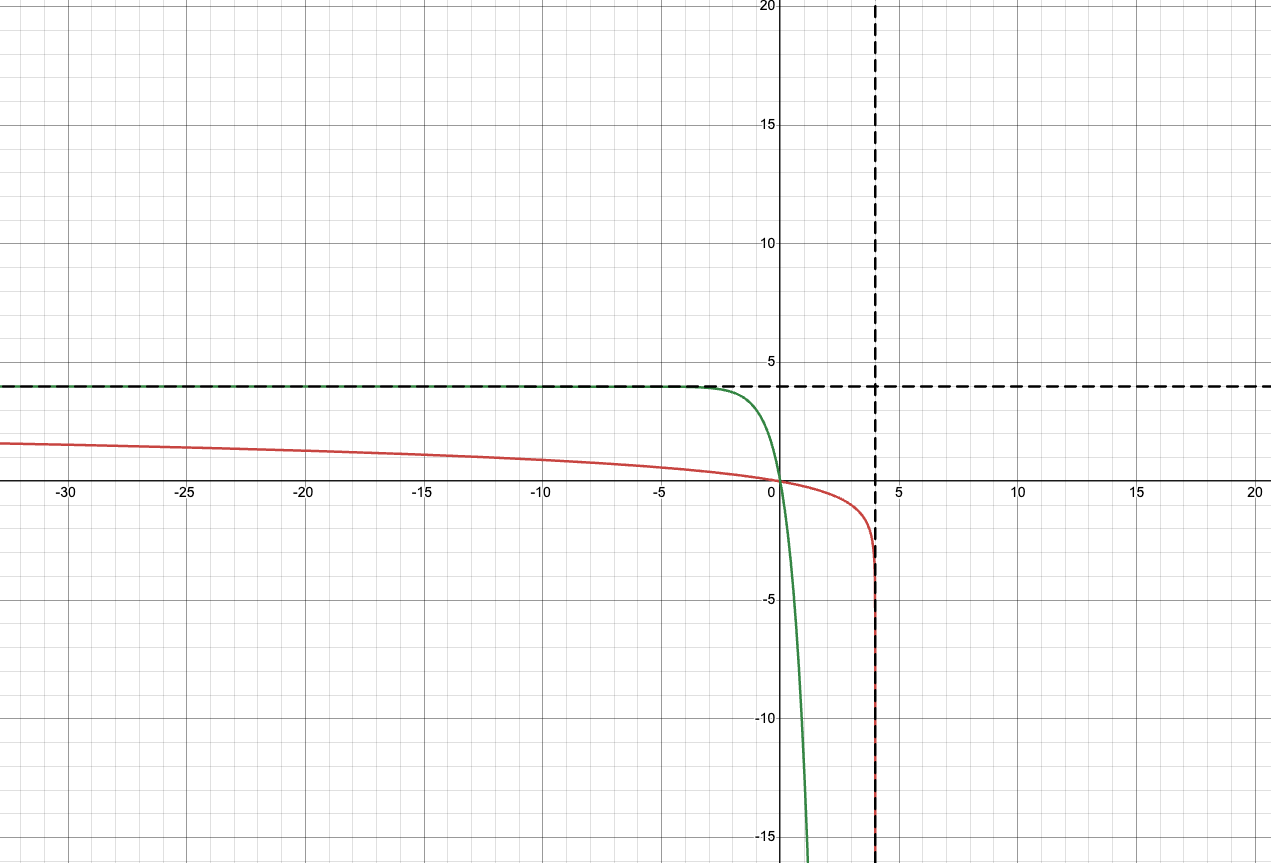
\[\boxed{h^{-1}(x)=4-4^{x+1}}.\]The inverse has domain \((-\infty,\infty)\) and range \((-\infty,4)\). The graphs of \(h\) and \(h^{-1}\) are reflections across the line \(y=x\).
The graph of both functions are shown below (green = inverse function):
Solution 12
The model is
\[P(t)=\frac{1200}{1+19e^{-0.4t}}.\]The initial population is
\[P(0)=\frac{1200}{1+19e^0} =\frac{1200}{20} =60.\]So
\[\boxed{P(0)=60}.\]As \(t\to\infty\),
\[e^{-0.4t}\to 0.\]Thus
\[P(t)\to \frac{1200}{1}=1200.\]So the limiting population is
\[\boxed{1200}.\]Now solve \(P(t)=900\):
\[900=\frac{1200}{1+19e^{-0.4t}}.\]Then
\[900(1+19e^{-0.4t})=1200.\]Divide by \(300\):
\[3(1+19e^{-0.4t})=4.\]So
\[1+19e^{-0.4t}=\frac43.\]Then
\[19e^{-0.4t}=\frac13.\]Thus
\[e^{-0.4t}=\frac1{57}.\]Take natural logs:
\[-0.4t=\ln\left(\frac1{57}\right)=-\ln 57.\]Therefore
\[t=\frac{\ln 57}{0.4} =\frac52\ln 57.\]So
\[\boxed{t=\frac52\ln 57}.\]Solution 13
Let
\[t=\log_4 n.\]Then
\[\log_{16} n=\frac{\log_4 n}{\log_4 16} =\frac{t}{2}.\]The equation becomes
\[\log_2\left(\frac{t}{2}\right)=\log_4(t).\]Rewrite both sides in base \(2\):
\[\log_2 t-\log_2 2=\frac{\log_2 t}{\log_2 4}.\]So
\[\log_2 t-1=\frac12\log_2 t.\]Then
\[\frac12\log_2 t=1.\]Thus
\[\log_2 t=2,\]so
\[t=4.\]Since \(t=\log_4 n\),
\[\log_4 n=4.\]Therefore
\[\boxed{n=4^4=256}.\]Solution 14
The function is
\[F(x)=\ln\left(\frac{x-a}{b-x}\right),\]where \(a<b\).
For the logarithm to be defined,
\[\frac{x-a}{b-x}>0.\]Since \(a<b\), this happens exactly when
\[a<x<b.\]So the domain is
\[\boxed{(a,b)}.\]For the \(x\)-intercept, set \(F(x)=0\):
\[\ln\left(\frac{x-a}{b-x}\right)=0.\]Then
\[\frac{x-a}{b-x}=1.\]So
\[x-a=b-x.\]Thus
\[2x=a+b,\]and
\[x=\frac{a+b}{2}.\]The \(x\)-intercept is
\[\boxed{\left(\frac{a+b}{2},0\right)}.\]The \(y\)-intercept exists only if \(0\) is in the domain, meaning
\[a<0<b.\]If this is true, then
\[F(0)=\ln\left(\frac{-a}{b}\right).\]So the \(y\)-intercept is
\[\boxed{\left(0,\ln\left(\frac{-a}{b}\right)\right)}\]if \(a<0<b\). Otherwise, there is no \(y\)-intercept.
The vertical asymptotes occur at the endpoints of the domain:
\[\boxed{x=a\quad\text{and}\quad x=b}.\]Now find the inverse. Let
\[y=\ln\left(\frac{x-a}{b-x}\right).\]Rewrite exponentially:
\[e^y=\frac{x-a}{b-x}.\]Multiply:
\[e^y(b-x)=x-a.\]Expand:
\[be^y-xe^y=x-a.\]Move the \(x\) terms together:
\[be^y+a=x+xe^y.\]Factor:
\[be^y+a=x(1+e^y).\]Thus
\[x=\frac{a+be^y}{1+e^y}.\]Switch \(x\) and \(y\):
\[\boxed{F^{-1}(x)=\frac{a+be^x}{1+e^x}}.\]As \(x\) moves through \((a,b)\), the ratio \(\frac{x-a}{b-x}\) moves through \((0,\infty)\), so the logarithm moves through all real numbers. Therefore the range is
\[\boxed{(-\infty,\infty)}.\]Solution 15
The product is
\[\prod_{k=4}^{63}\frac{\log_k\left(5^{k^2-1}\right)}{\log_{k+1}\left(5^{k^2-4}\right)}.\]Use change of base:
\[\log_k\left(5^{k^2-1}\right) =\frac{(k^2-1)\ln 5}{\ln k},\]and
\[\log_{k+1}\left(5^{k^2-4}\right) =\frac{(k^2-4)\ln 5}{\ln(k+1)}.\]So each factor becomes
\[\frac{\frac{(k^2-1)\ln 5}{\ln k}}{\frac{(k^2-4)\ln 5}{\ln(k+1)}} =\frac{k^2-1}{k^2-4}\cdot\frac{\ln(k+1)}{\ln k}.\]Factor the polynomials:
\[\frac{k^2-1}{k^2-4} =\frac{(k-1)(k+1)}{(k-2)(k+2)}.\]Thus the product is
\[\prod_{k=4}^{63} \frac{(k-1)(k+1)}{(k-2)(k+2)} \cdot \prod_{k=4}^{63}\frac{\ln(k+1)}{\ln k}.\]First,
\[\prod_{k=4}^{63}\frac{k-1}{k-2} =\frac32\cdot\frac43\cdot\frac54\cdots\frac{62}{61} =31.\]Also,
\[\prod_{k=4}^{63}\frac{k+1}{k+2} =\frac56\cdot\frac67\cdot\frac78\cdots\frac{64}{65} =\frac5{65} =\frac1{13}.\]So the rational part is
\[31\cdot\frac1{13}=\frac{31}{13}.\]The logarithm part telescopes:
\[\prod_{k=4}^{63}\frac{\ln(k+1)}{\ln k} =\frac{\ln 5}{\ln 4}\cdot\frac{\ln 6}{\ln 5}\cdots\frac{\ln 64}{\ln 63} =\frac{\ln 64}{\ln 4}.\]Since \(64=4^3\),
\[\frac{\ln 64}{\ln 4}=3.\]Therefore the product is
\[\frac{31}{13}\cdot 3=\boxed{\frac{93}{13}}.\]Solution 16
For part \((A)\),
\[\operatorname{EML}(x,1)=e^x-\ln 1.\]Since \(\ln 1=0\),
\[\operatorname{EML}(x,1)=e^x.\]Thus
\[\boxed{e^x=\operatorname{EML}(x,1)}.\]For part \((B)\),
\[\operatorname{EML}(0,x)=e^0-\ln x.\]Since \(e^0=1\),
\[\operatorname{EML}(0,x)=1-\ln x.\]Solving for \(\ln x\) gives
\[\boxed{\ln x=1-\operatorname{EML}(0,x)}.\]For part \((C)\), use change of base:
\[\log_b x=\frac{\ln x}{\ln b}.\]Using part \((B)\),
\[\ln x=1-\operatorname{EML}(0,x)\]and
\[\ln b=1-\operatorname{EML}(0,b).\]Therefore
\[\boxed{\log_b x=\frac{1-\operatorname{EML}(0,x)}{1-\operatorname{EML}(0,b)}}.\]For part \((D)\), use
\[e^x=\operatorname{EML}(x,1)\]and
\[\ln z=1-\operatorname{EML}(0,z).\]Since
\[x+y=\ln(e^xe^y),\]we get
\[\boxed{x+y=1-\operatorname{EML}\left(0,\operatorname{EML}(x,1)\operatorname{EML}(y,1)\right)}.\]Similarly,
\[x-y=\ln\left(\frac{e^x}{e^y}\right),\]so
\[\boxed{x-y=1-\operatorname{EML}\left(0,\frac{\operatorname{EML}(x,1)}{\operatorname{EML}(y,1)}\right)}.\]For part \((E)\), the tree for
\[\operatorname{EML}\left(\operatorname{EML}(x,1),\operatorname{EML}(0,y)\right)\]has a top EML node. Its left input is another EML node with inputs \(x\) and \(1\). Its right input is another EML node with inputs \(0\) and \(y\).
In text form:
\[\operatorname{EML} \left( \begin{array}{c} \operatorname{EML}(x,1),\\ \operatorname{EML}(0,y) \end{array} \right).\]Now simplify:
\[\operatorname{EML}(x,1)=e^x\]and
\[\operatorname{EML}(0,y)=1-\ln y.\]Therefore
\[\operatorname{EML}\left(\operatorname{EML}(x,1),\operatorname{EML}(0,y)\right) =\operatorname{EML}(e^x,1-\ln y).\]Using the definition of EML,
\[\operatorname{EML}(e^x,1-\ln y) =e^{e^x}-\ln(1-\ln y).\]So the expression simplifies to
\[\boxed{e^{e^x}-\ln(1-\ln y)}.\]This requires
\[1-\ln y>0,\]so
\[0<y<e.\]For part \((F)\), the comparison is that both EML and NAND are examples of a very small set of building blocks being powerful enough to generate a much larger system. A NAND gate alone can build NOT, AND, OR, and therefore all Boolean logic circuits. Similarly, the paper claims that EML, together with the constant \(1\), can be composed into trees that represent the standard elementary functions. In both cases, complicated expressions can be built from repeated uses of one simple operation.