Unit 4: Chemical Reactions
Chemical reactions convert reactants into products by breaking and forming bonds so that atoms are rearranged into new substances. This unit classifies common patterns you will use everywhere on the AP exam—especially with aqueous ions, acids and bases, and redox. Stoichiometry rests on conservation of mass (balanced equations) and connects to moles and concentration from Unit 1. Polarity, solubility, and solutions tie back to Unit 3.
Physical versus chemical change
- A chemical change produces new substances with new chemical identities. Observable clues include a lasting color change, gas evolution (from something other than simple boiling), formation of a precipitate, a large temperature change from the reaction itself, light emission, or a new odor. Those clues are suggestive, not proof; the decisive idea is reorganization at the molecular level (bond breaking and forming).
- A physical change alters state, size, shape, or mixing without creating a new chemical species: melting, boiling, dissolving sugar in water (the sucrose molecules remain intact), or crushing a sample. Dissolving an ionic compound in water is still often grouped with “physical” solution formation in introductory courses, even though the ions separate from the crystal—a distinction worth keeping straight when you discuss conductivity and equilibrium later.
Representing and balancing reactions
A chemical equation lists reactants (left) and products (right), usually separated by a single arrow \((\longrightarrow)\) for a reaction treated as one-way in stoichiometry, or \((\rightleftharpoons)\) when equilibrium matters (Unit 7). State symbols clarify what you are counting:
\((s)\) solid, \((l)\) liquid, \((g)\) gas, \((aq)\) dissolved in water (aqueous).
If an element is a component of the reaction ALONE, they are written in their standard/naturally-occuring form (e.g. \(\text{O}_2(g)\), \(\text{Na}(s)\), \(\text{Br}_2(l)\)). Otherwise, they can take on any form. Coefficients are the smallest integers (or a set of integers) consistent with conservation of atoms: they give mole ratios for limiting-reactant work, titrations, and gas-law stoichiometry. Make sure that on each side of a reaction, you start and end with the same number of atoms/moles.
Balancing by inspection (non-redox and simple cases)
- Balance elements that appear in only one reactant and one product first (often metals or central atoms).
- Treat unchanged polyatomic ions (such as \(\text{NO}_3^-\) or \(\text{SO}_4^{2-}\)) as a unit if they appear intact on both sides (Make sure to include them in brackets, otherwise they do not count as polyatomic ions).
- Balance hydrogen and oxygen last when they appear in several compounds (common in combustion and acid–base).
- If you temporarily need a fractional coefficient to balance an element (e.g. \(\frac{1}{2}\text{O}_2\)), multiply the entire equation by the denominator so all coefficients are integers.
The balanced equation conserves mass (atom counts). For ionic reactions in solution, you may also write:
-
Molecular equation — Molecular formulas are formulas as written in the bottle/usually stated in the problem (e.g. \(\text{AgNO}_3(aq) + \text{NaCl}(aq)\))
-
Total ionic equation — You treat strong electrolytes as separated ions, while solids, liquids, weak electrolytes, and gases usually undissociated (Check solubility rules below for electrolytes; strong electrolytes are soluble in water)
-
Net ionic equation — Write the total ionic equation but cancel spectator ions that do not change (Basically anything that can cancel on both sides) and only species that actually react
Redox reactions in acidic or basic solution often needs the half-reaction method (below) because oxidation numbers change and electron and charge balance are not handled by atom counting alone.
Double-displacement (metathesis) and precipitation
In a double-displacement reaction, cations and anions exchange partners, often in solution:
\[\text{AB}(aq) + \text{CD}(aq) \longrightarrow \text{AD} (aq) + \text{CB} (s)\]If one combination is insoluble (in the example above it is \(CB\)), it forms a precipitate, a solid that may appear as cloudiness, flecks, or a settled solid at the bottom of the vessel. Different precipitates will have different colors, which may be useful in determining the contents of the reaction. If all ionic products remain soluble (aqueous), no net reaction occurs.
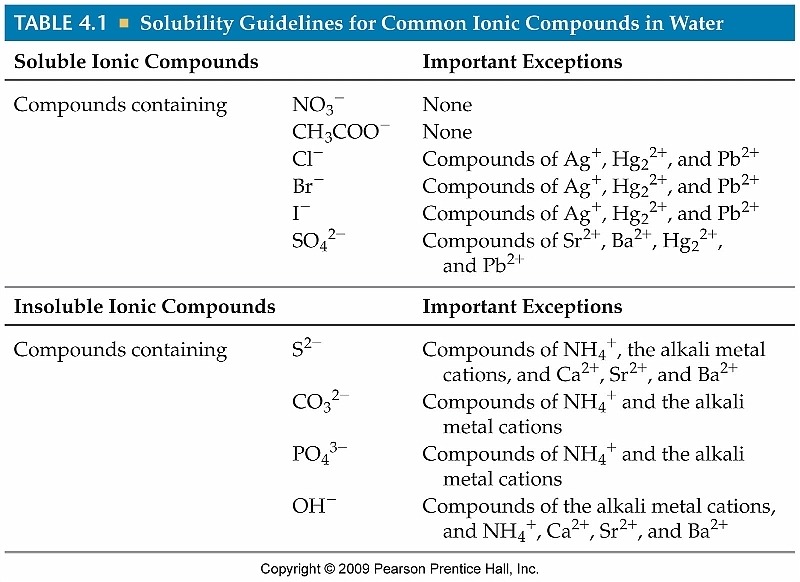
You predict precipitates with solubility rules, which are very important to memorize. These rules are general AP-level shortcuts; a few exceptions exist, and exact solubility is handled later with \(K_{sp}\).
| Usually soluble | Important exceptions |
|---|---|
| Group 1 cations and \(\text{NH}_4^+\) salts | No common exceptions |
| \(\text{NO}_3^-\), \(\text{C}_2\text{H}_3\text{O}_2^-\) / \(\text{CH}_3\text{COO}^-\), \(\text{ClO}_3^-\), \(\text{ClO}_4^-\) | No common exceptions |
| \(\text{Cl}^-\), \(\text{Br}^-\), \(\text{I}^-\) | Insoluble with \(\text{Ag}^+\), \(\text{Pb}^{2+}\), and \(\text{Hg}_2^{2+}\) |
| \(\text{SO}_4^{2-}\) | Insoluble or only slightly soluble with \(\text{Ba}^{2+}\), \(\text{Sr}^{2+}\), \(\text{Pb}^{2+}\), \(\text{Ca}^{2+}\), and \(\text{Hg}_2^{2+}\) |
| Usually insoluble | Important exceptions |
|---|---|
| \(\text{CO}_3^{2-}\), \(\text{PO}_4^{3-}\), \(\text{CrO}_4^{2-}\), \(\text{S}^{2-}\) | Soluble with Group 1 cations and \(\text{NH}_4^+\) |
| \(\text{OH}^-\) | Soluble with Group 1 cations and \(\text{NH}_4^+\); \(\text{Ba}^{2+}\), \(\text{Sr}^{2+}\), and \(\text{Ca}^{2+}\) hydroxides are more soluble than most other metal hydroxides |
For a precipitation prediction, swap ion partners, apply the table, and write a net ionic equation only for the solid that forms. Example:
\[\text{Ag}^+(aq) + \text{Cl}^-(aq) \longrightarrow \text{AgCl}(s)\]Acid–base (neutralization) reactions
Neutralization between a strong acid and strong base yields water and an ionic salt:
\[\text{acid} + \text{base} \longrightarrow \text{salt} + \text{H}_2\text{O}.\]Such proton-transfer reactions are often rapid because water is a very stable product. This is a special form of a double-displacement reaction
Reactions of metal carbonates (and bicarbonates) with acid produce carbon dioxide as well, because carbonic acid is unstable and decomposes:
\[\text{H}_2\text{CO}_3 \longrightarrow \text{H}_2\text{O} + \text{CO}_2.\]Metal oxides (basic anhydrides) react with acids like other bases as well, just giving up the oxygen to water instead of hydrogen.
Combination, decomposition, and combustion
Synthesis (combination) builds one product from simpler reactants. Note that all reactants have to be in their natural state (e.g. \(O_2 (g)\) or \(Na (s)\)):
\[\text{A} + \text{B} \longrightarrow \text{AB}.\]Decomposition is the reverse picture: one compound breaks into smaller pieces, often with heat or electricity. Note that all products have to be in their natural state (e.g. \(N_2 (g)\) or \(Rb (s)\)):
\[\text{AB} \longrightarrow \text{A} + \text{B}.\]Combustion of a hydrocarbon in excess oxygen produces carbon dioxide and water (and other products if the fuel contains other elements such as sulfur). Incomplete combustion can yield \(\text{CO}\) or soot (carbon):
\[\text{Hydrocarbon} + O_2 \longrightarrow CO_2 (g) + H_2O (g / l).\]As usual, you should balance coefficients to make a balanced equation.
Single-displacement reactions
In single-displacement, an element in its standard state replaces ions of another element in solution (or in a melt). For metals (and hydrogen in acid), activity order decides whether reaction occurs: a metal higher in the activity series reduces the cation of a metal below it. Hydrogen’s position marks which metals react with dilute acid to liberate \(\text{H}_2\).
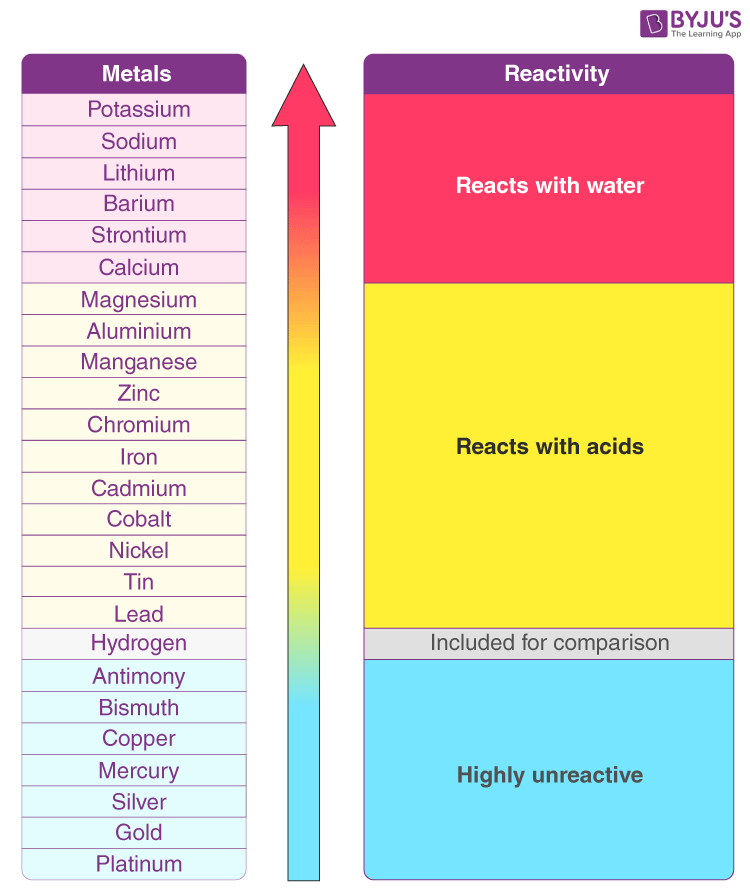
For halogens, a more reactive halogen displaces the halide ion of a less reactive halogen from solution. Reactivity decreases down the group (\(\text{F}_2 > \text{Cl}_2 > \text{Br}_2 > \text{I}_2\)).
Oxidation–reduction (redox)
Redox reactions transfer electrons between species. Oxidation is loss of electrons (increase in oxidation number); reduction is gain of electrons (decrease in oxidation number). A very helpful mnemonic is OIL RIG: Oxidation Is Losing, Reduction Is Gaining.
The reducing agent is the one being oxidized, and the oxidizing agent is the one being reduced. Assigning oxidation states to every atom in a formula is the standard bookkeeping method (refer to Unit 1). Many combustion, single-displacement, and electrochemical processes are redox; they are often slower in the lab than simple precipitation or strong acid–strong base neutralization because covalent bonds must break and form in the elemental or molecular reactants.
Half-reactions (oxidation and reduction)
A half-reaction shows only the oxidation or only the reduction part of an electron transfer. Electrons \((e^-)\) appear as a product in the oxidation half-reaction (electrons are lost) and as a reactant in the reduction half-reaction (electrons are gained). After each half-reaction is balanced for atoms and charge, you multiply one or both by integers so the number of electrons lost equals the number gained, then add the half-reactions and cancel duplicated species (including \(e^-\), \(\text{H}_2\text{O}\), \(\text{H}^+\), or \(\text{OH}^-\)).
Acidic solutions (common AP setup):
-
Split the net ionic transformation into oxidation and reduction halves.
-
Balance all atoms except O and H.
-
Balance O with \(\text{H}_2\text{O}\).
-
Balance H with \(\text{H}^+\).
-
Balance charge with \(e^-\) on the correct side.
-
Equalize electrons; add the halves; simplify.
Basic solution: either balance as in acid and then add \(\text{OH}^-\) to both sides in pairs that neutralize \(\text{H}^+\) as water, or balance using \(\text{H}_2\text{O}\) and \(\text{OH}^-\) from the start. The final combined equation should contain no free \(\text{H}^+\) if the medium is strongly basic.
Half-reactions are a very important compenents of galvanic and electrolytic cells (wiring oxidation at the anode and reduction at the cathode) and of standard reduction potentials tabulated for half-reactions written as reduction by convention. You will learn more in Unit 9.
Solubility and “like dissolves like”
Solubility is the maximum amount of solute that dissolves in a given amount of solvent at a specified temperature. Polar and ionic solutes tend to dissolve in polar solvents (usually water); nonpolar solutes tend to dissolve in nonpolar solvents. At the particle level, ion–dipole interactions or hydrogen bonding stabilize ions or polar molecules in water; nonpolar solutes rely mainly on weaker dispersion forces to mix with nonpolar solvents.
By convention, the solvent is the component present in greater amount and the solute is the dissolved component (by convention in dilute lab work, the minor component).
Factors affecting solubility
Common-ion effect: for a sparingly soluble salt in equilibrium with its solid, adding another source of the same cation or anion shifts equilibrium toward solid, lowering molar solubility. (The full equilibrium lecture is in Unit 7.)
Temperature: the effect on solid solubility depends on the sign of enthalpy of solution: many ionic solids become more soluble as \(T\) rises, but exceptions exist. Gases in liquids almost always become less soluble as \(T\) rises (molecular kinetic picture: escape from solution is easier when molecules move faster). Pressure has little effect on solid or liquid solutes but strongly affects gas solubility (Henry’s law in Unit 3).
Concentration measures (revisited)
Molarity \(M\) is moles of solute per liter of solution (\(\text{mol/L}\)); it changes slightly with temperature because volume changes.
Molality \(m\) is moles of solute per kilogram of solvent (not kilogram of solution):
\[m = \frac{\text{moles of solute}}{\text{kilograms of solvent}}.\]It is temperature-independent in the sense that it uses mass of solvent, not volume of solution.
Mass percent is
\[\text{mass \%} = \frac{\text{mass of solute}}{\text{mass of solution}} \times 100\%.\]Parts per million and parts per billion report a mass ratio (or, for dilute aqueous work, often \(\text{mg}\) solute per \(\text{kg}\) solution, which is approximately \(\text{mg/L}\) for water):
\[\text{ppm} = \frac{\text{mass of solute}}{\text{mass of sample}} \times 10^6, \qquad \text{ppb} = \frac{\text{mass of solute}}{\text{mass of sample}} \times 10^9.\]Do not equate \(\text{ppm}\) to “\(mass \% \times 10^6\)”; use the fraction definition above (for example, \(1\%\) corresponds to \(10^4\) ppm).
Normality \(N\) (still seen in some labs) is equivalents of reacting species per liter of solution: for acid–base, one equivalent of acid is one mole of \(\text{H}^+\) donated per mole of formula (so \(\text{H}_2\text{SO}_4\) can be \(2N\) when both protons count in that context). On the AP exam, molarity and stoichiometry from the balanced equation are usually enough.
Colloids
A colloid contains dispersed particles larger than single molecules but small enough to stay suspended (roughly \(1\)–\(1000\ \text{nm}\) is a common textbook range). Colloids are thermodynamically unstable with respect to bulk phase separation but can be kinetically persistent; charged surfaces and electrostatic repulsion often slow aggregation.
- The Tyndall effect is the scattering of visible light by those particles, a practical way to distinguish many colloids from true solutions. For example, milk is a colloid because it scatters light, one reason why it appears white
- Coagulation (heating, adding electrolyte, or mixing) can collapse the dispersion so particles aggregate and settle, just like how milk clumps can settle when milk isn’t properly refrigerated